A Masterpiece at the Edge of Visibility
Art is usually something we expect to stand in front of, step back from, and admire with our own eyes. A painting might fill a gallery wall, stretch across a ceiling, or sit proudly in a frame above a fireplace. But some artworks challenge that expectation completely. Instead of asking viewers to step back, they ask them to zoom in—far in.
The smallest paintings ever created belong to the fascinating world of micro-art and nano-art, where the canvas can be smaller than a grain of dust and the details are invisible without a microscope. These record-breaking works are not just artistic curiosities; they are feats of patience, engineering, science, and imagination. They prove that creativity does not depend on size. Sometimes, the most astonishing artworks are the ones you can barely see.
What Makes a Painting “The Smallest”?
When people talk about the smallest painting ever created, the answer can depend on how “painting” is defined. Traditional miniature artists may use handmade brushes to paint on seeds, grains of rice, or the heads of pins. Scientific nano-artists, however, create images using advanced tools such as atomic force microscopes, lasers, and nanolithography.
One of the most famous examples is the microscopic “Mini Lisa,” a tiny recreation of Leonardo da Vinci’s Mona Lisa created by researchers at the Georgia Institute of Technology. Measuring about 30 microns wide, it is so small that several versions could fit across the width of a single human hair. To the naked eye, it is invisible. Under a microscope, however, it reveals a recognizable portrait with shading, form, and expression.
This is what makes microscopic art so compelling: the artwork exists in the real world, but it lives beyond ordinary human perception. It is not imaginary, digital, or symbolic. It is physically there—just unbelievably small.
How Do You Paint Something That Small?
A traditional painter relies on brushes, pigments, canvas, and hand movement. But at the microscopic scale, even the tiniest brush would be far too large. The slightest vibration, a breath of air, or a speck of dust could ruin the entire piece.
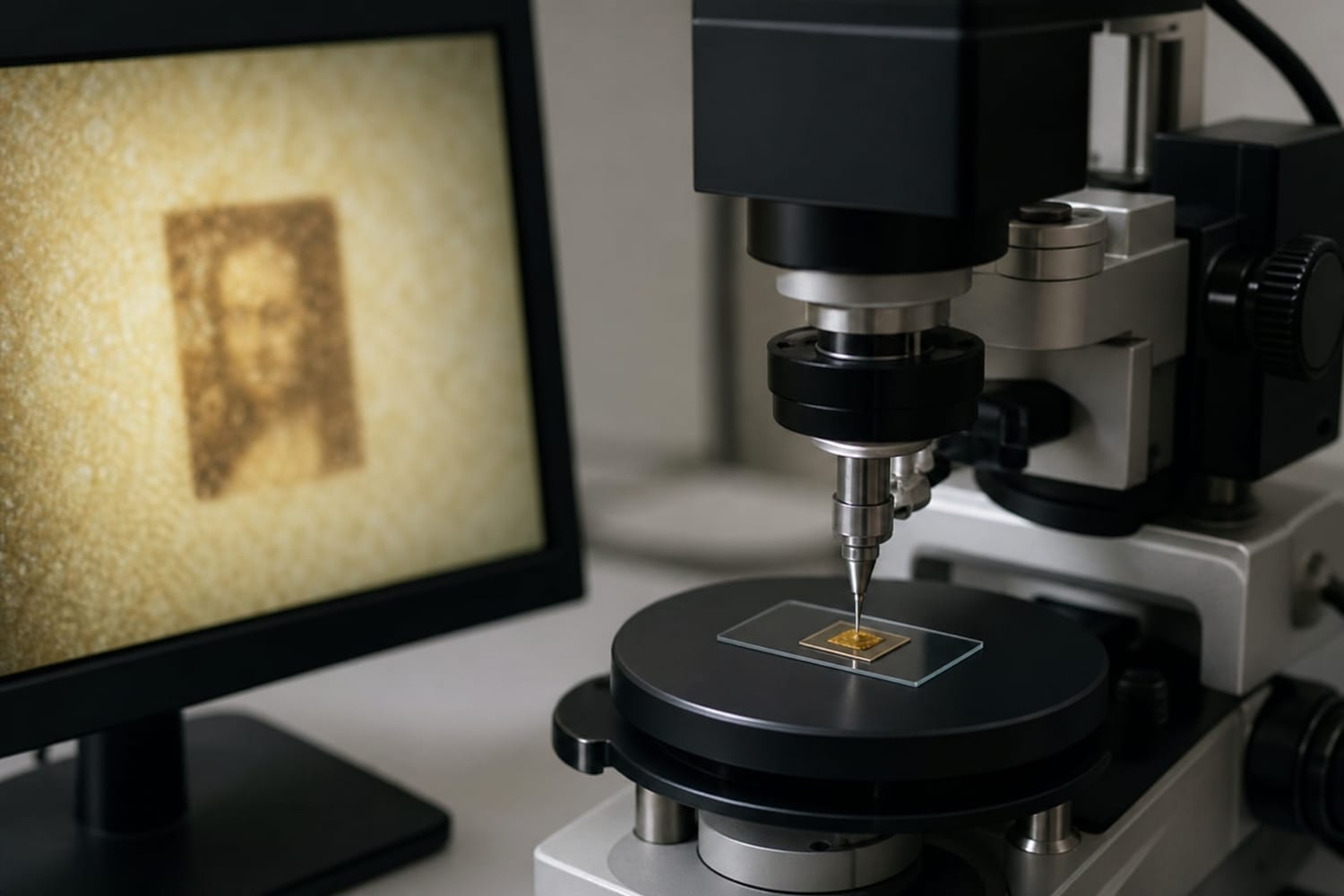
Nano-artworks like the “Mini Lisa” are made using scientific instruments rather than conventional art supplies. In this case, researchers used a technique called thermochemical nanolithography. Instead of applying paint, they used a heated nanoscale tip to change the chemical properties of a surface. By carefully controlling the temperature, they produced different shades, allowing the image to appear with light and dark areas.
In other words, the “paint” was not paint in the traditional sense. The “brush” was a microscopic tool. The “canvas” was a specially prepared surface. Yet the result still functioned like a painting: an image created through deliberate marks, tonal variation, and artistic intention.
This raises a fascinating question: does art require traditional materials, or does it only require vision and execution? Micro-art suggests that the spirit of painting can survive even when the brush disappears.
Why Choose the Mona Lisa?
The Mona Lisa is one of the most recognizable paintings in the world, which makes it a perfect subject for a microscopic tribute. Even when reduced to a nearly invisible scale, the image remains familiar. The mysterious smile, the face, and the composition all carry cultural weight.
Choosing such an iconic painting also creates a dramatic contrast. Leonardo da Vinci’s original masterpiece is famous for its subtle brushwork, atmospheric perspective, and human expression. Recreating it at a scale smaller than a dust particle transforms it into something entirely new. It becomes both a homage to classical art and a demonstration of modern technology.
The miniature version does not replace the original, of course. Instead, it invites us to think about how images travel through time, materials, and scales. A Renaissance portrait can become a nanoscale experiment. A museum icon can become a scientific achievement. Art history and nanotechnology meet in a space too small for the eye to enter.
Seeing It Requires More Than Good Eyes
Most paintings are made to be viewed directly. Even tiny miniatures on rice grains or pinheads can sometimes be seen with a magnifying glass. But nanoscale artworks require serious magnification. A standard glance will reveal nothing. Even holding the artwork in your hand would not help, because the human eye simply cannot resolve details that small.

To view such a painting, you need a microscope capable of revealing features measured in microns or nanometers. This adds another layer to the experience. The viewer does not simply look at the artwork; they access it through technology.
That changes the relationship between audience and art. The microscope becomes part of the viewing experience, almost like a gallery frame or spotlight. Without it, the painting is hidden. With it, the invisible becomes visible.
There is something poetic about that. The artwork waits quietly at a scale we cannot naturally perceive, reminding us that the world contains countless details beyond our senses.
The Patience Behind Microscopic Art
Creating art at this scale requires extraordinary control. Micro-artists who work by hand often train themselves to slow their breathing, steady their heartbeat, and make movements between pulses. Some use single hairs as brushes. Others paint under magnification for hours, knowing that one tiny mistake could destroy the work.
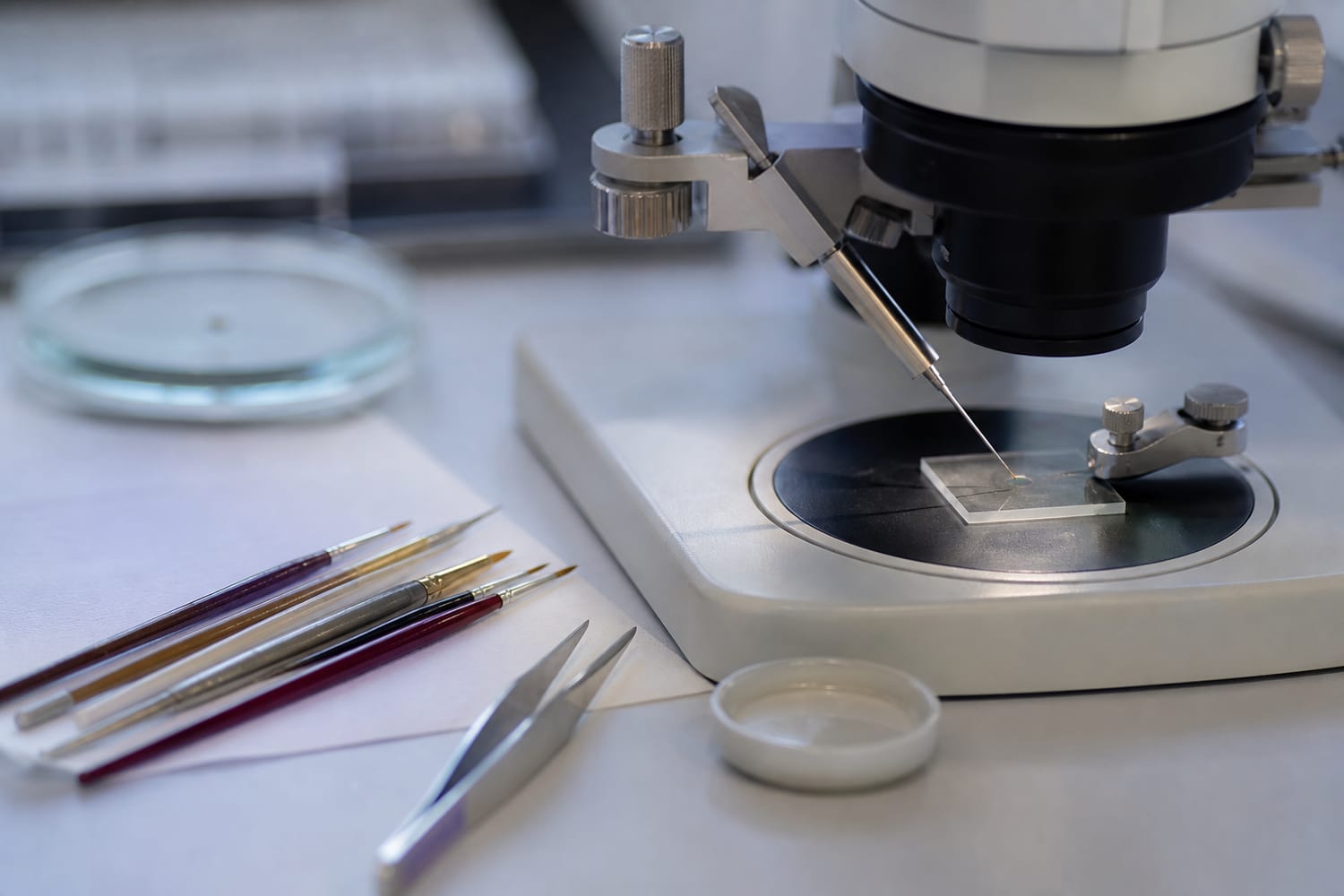
Scientific nano-art involves a different kind of discipline. It requires precision instruments, controlled environments, and deep knowledge of materials. The artist or researcher must understand not only composition but also physics, chemistry, and surface behavior.
Whether made by hand or machine, the smallest paintings demand patience at an almost unbelievable level. The process is often slower, more technical, and more fragile than traditional painting. That difficulty is part of the wonder. The finished piece may be tiny, but the effort behind it is enormous.
Why Microscopic Art Matters
It is easy to dismiss microscopic paintings as novelty pieces—interesting because they are small, but not much more. Yet they matter for several reasons.
First, they expand the definition of art. They show that creativity can happen at any scale, from monumental murals to nanoscale portraits. Art is not limited to what hangs in galleries.
Second, they connect art and science. Many microscopic artworks are created with tools originally designed for research, manufacturing, or materials science. By using those tools creatively, artists and scientists reveal unexpected beauty in technical processes.
Third, they inspire curiosity. A microscopic painting encourages people to ask questions: How was it made? What tool could create such detail? What else exists beyond what we can see? In that sense, the artwork becomes a doorway into science, perception, and imagination.
Finally, these works remind us that human beings love extremes. We are fascinated by the tallest buildings, the deepest oceans, the fastest machines, and the smallest artworks. Records capture attention because they push the limits of what seems possible.
The Big Impact of Tiny Art
The smallest painting ever created may not dominate a room, but it can dominate the imagination. Its power lies in contradiction. It is physically tiny but conceptually huge. It is nearly invisible, yet globally fascinating. It may require a microscope to view, but its meaning is easy to understand: human creativity has no fixed size.
In a world where bigger is often treated as better, microscopic art offers a refreshing reversal. It tells us that significance is not measured in inches, feet, or meters. Sometimes, the smallest object can hold the largest sense of wonder.
The next time you see a famous painting in a museum or a large mural on a city wall, remember that somewhere, on a surface smaller than a speck of dust, an artist or scientist may have created an entire masterpiece. You may need a microscope to see it, but once you understand what it represents, it becomes impossible to ignore.