In the city of Mandalay, Myanmar, there is a book unlike any other on Earth. It cannot be held in two hands, slipped into a bag, or placed on a shelf. Its pages are not paper, parchment, or palm leaf. Instead, they are carved from marble—729 stone slabs standing in neat rows around the gleaming white stupas of Kuthodaw Pagoda.
Known as the “world’s largest book,” this extraordinary monument contains the entire Pali Canon, the sacred scriptures of Theravada Buddhism. Each slab represents a page, and each page is housed in its own small white shrine. Together, they form a vast library in stone, a place where architecture, religion, history, and literature meet.
The result is not just a record of words, but a breathtaking act of preservation. Long before digital archives and cloud storage, King Mindon of Burma set out to protect Buddhist teachings from loss, decay, and political uncertainty. His solution was both practical and poetic: carve the scriptures into marble so they could endure for generations.
A Book Too Large to Turn
Calling Kuthodaw Pagoda’s marble collection a “book” may seem surprising at first. There is no cover, spine, or binding. Yet the comparison makes perfect sense once you understand its purpose. The 729 slabs are arranged like pages, each inscribed with text from the Tipitaka, also known as the Pali Canon.
The Tipitaka is the central scripture of Theravada Buddhism. Its name means “Three Baskets,” referring to the three major collections of teachings: the Vinaya Pitaka, which contains rules for monastic life; the Sutta Pitaka, which includes discourses attributed to the Buddha; and the Abhidhamma Pitaka, a more philosophical and analytical body of texts.
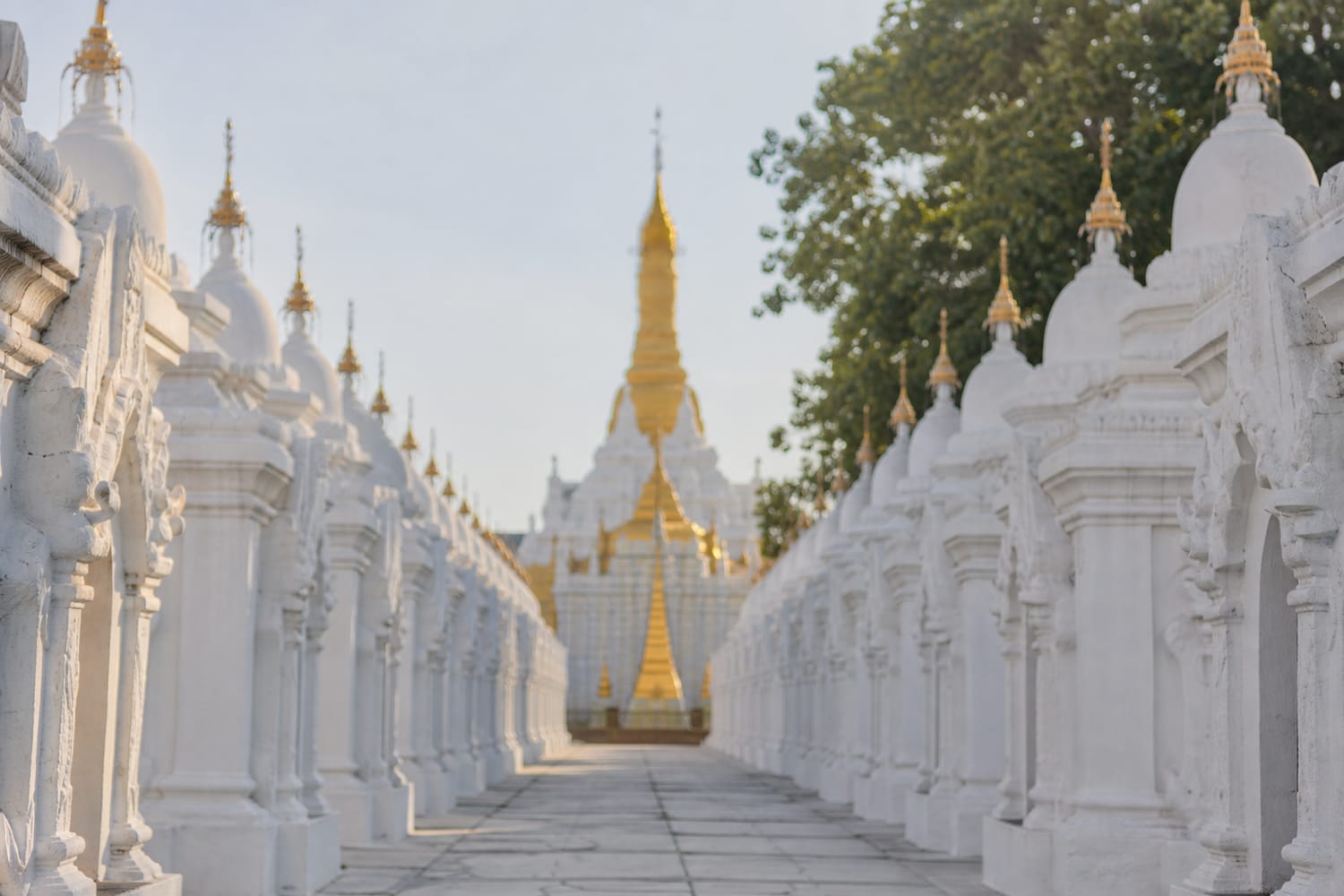
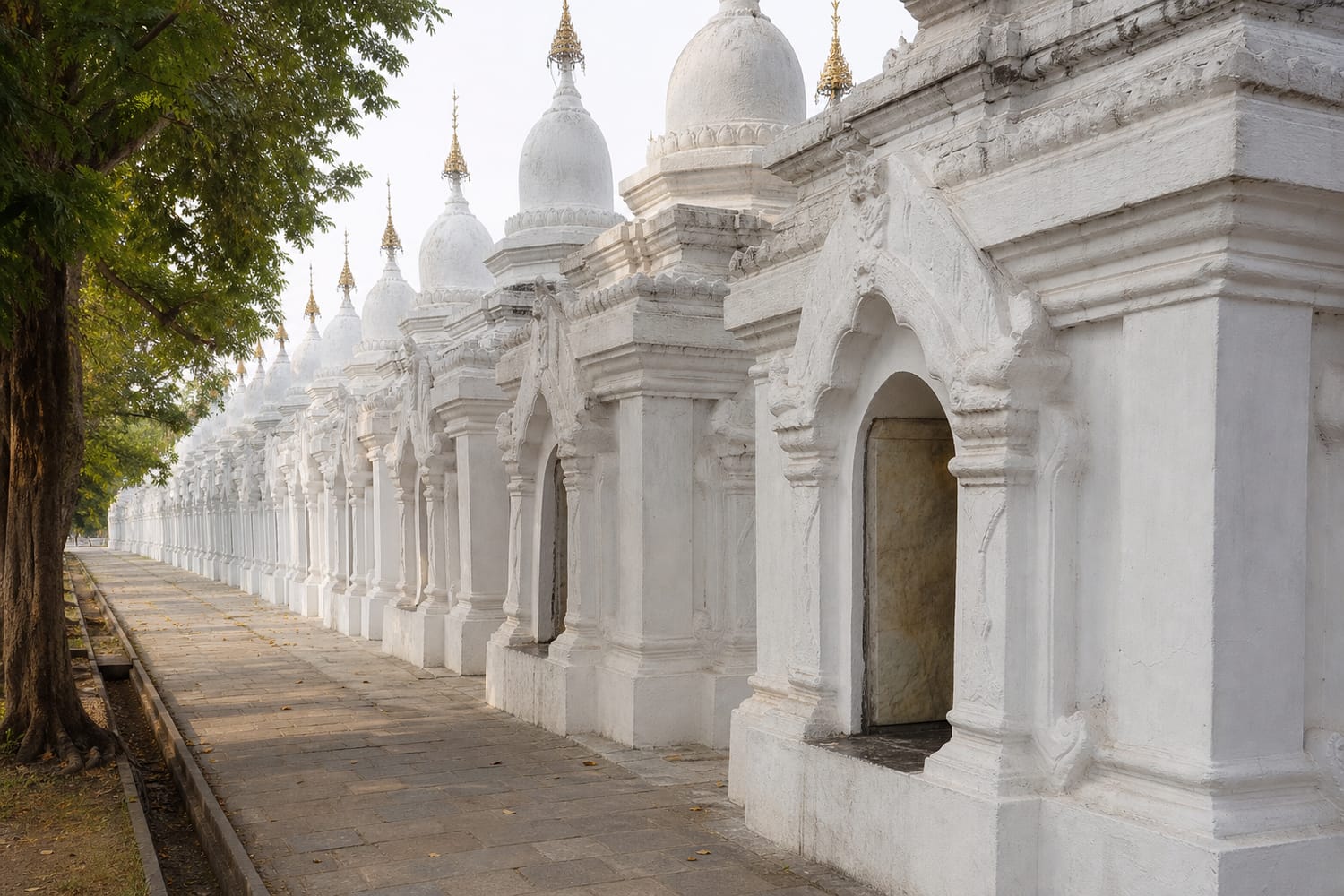
To preserve all of this material, scribes and artisans carved thousands upon thousands of lines into marble. Each slab stands upright and is protected inside a small structure known as a kyauksa gu, or stone-inscription cave. From a distance, these small white shrines look like hundreds of miniature stupas gathered around the central golden pagoda.
The scale is difficult to appreciate until you imagine walking through it. Instead of flipping pages, visitors move from slab to slab. Instead of reading under a lamp, they read beneath the open sky, surrounded by sacred architecture.
The Vision of King Mindon
The creation of the world’s largest book was largely the vision of King Mindon Min, one of the last kings of Burma. He ruled from 1853 to 1878, during a time of great change and pressure. British colonial power was expanding in the region, and Burma’s political future was increasingly uncertain.
King Mindon was deeply committed to Buddhism and saw himself as a guardian of the faith. He wanted to ensure that the teachings of the Buddha would survive not only in monasteries and manuscripts, but in a form that could withstand time, climate, conflict, and human error.
In 1857, King Mindon founded Mandalay as a new royal capital. Kuthodaw Pagoda was built near Mandalay Hill as part of this sacred and royal landscape. The project of inscribing the Buddhist scriptures onto stone began soon after and became one of the most ambitious religious undertakings of the period.
The work was connected to the Fifth Buddhist Council, held in Mandalay in 1871. During this council, learned monks reviewed and recited the Pali Canon to ensure its accuracy. The corrected and approved text was then preserved in marble, giving the monument both spiritual authority and historical importance.
How the Marble Pages Were Made
Each of the 729 marble slabs was carefully prepared, polished, and inscribed. The slabs are roughly five feet tall, three and a half feet wide, and several inches thick. On both sides of each slab, artisans carved the Pali text in Burmese script.
This was painstaking work. Every letter had to be carved accurately, because even a small mistake in a sacred text mattered. Once the inscriptions were completed, the letters were reportedly filled with gold ink, making the words shine against the pale stone. Although much of that original gold has disappeared over time, the carved letters remain.
The slabs were then placed inside their own individual shrines. These small white structures protect the inscriptions from direct exposure while also creating a visually stunning environment. They are arranged in orderly rows around the main pagoda, forming a sacred library that visitors can walk through.
The project took years to complete and required the labor of scholars, monks, stonecutters, craftsmen, and royal officials. It was not simply an artistic project; it was an enormous act of coordination and devotion.
Kuthodaw Pagoda and Its Sacred Setting
At the center of the site stands Kuthodaw Pagoda, a graceful gilded stupa modeled in part after the famous Shwezigon Pagoda in Bagan. The name “Kuthodaw” is often translated as “Royal Merit,” reflecting the Buddhist idea that supporting religious works generates spiritual merit.
Surrounding the central stupa are the 729 marble-inscription shrines. Their bright white surfaces contrast beautifully with the gold of the central pagoda and the green slopes of nearby Mandalay Hill. The symmetry of the layout gives the site a calm, contemplative quality.
Visitors often describe the experience as peaceful and almost dreamlike. The repeated forms of the small shrines create a rhythm, while the inscriptions remind people that this beauty serves a deeper purpose. It is not decoration alone—it is scripture made architectural.
Nearby is Sandamuni Pagoda, another important site with many inscribed stone slabs. Together, these monuments make Mandalay one of the most remarkable places in the world for anyone interested in Buddhist textual history.
Why Marble Was Chosen
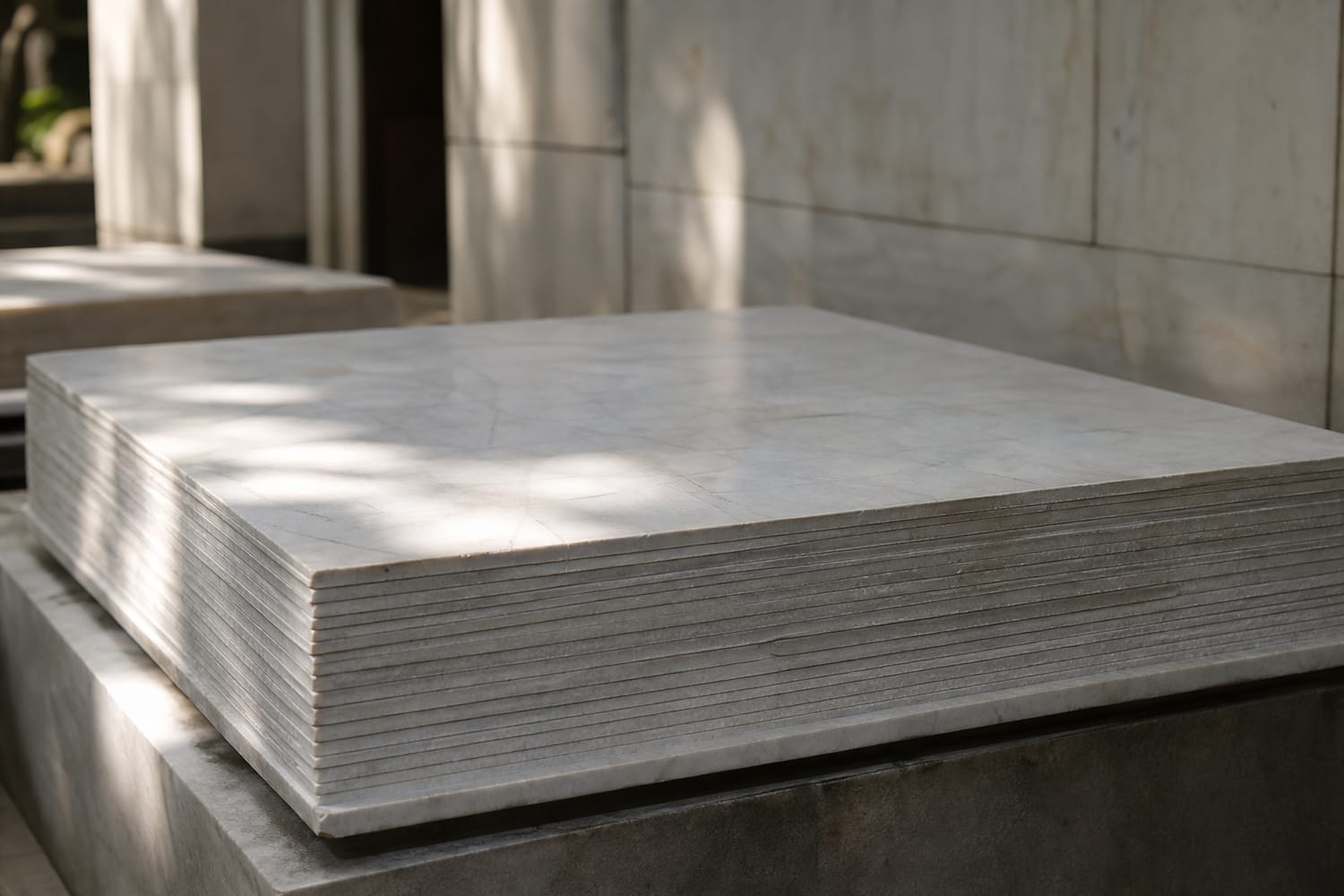
Marble was selected because it offered durability. Traditional manuscripts in Southeast Asia were often written on palm leaves, which could decay, burn, or be damaged by insects and humidity. Even when carefully preserved, such manuscripts had to be recopied over time.
Stone, by contrast, promises permanence. By carving the scriptures into marble, King Mindon hoped to create a version of the Buddhist canon that could survive for centuries. The material itself became part of the message: these teachings were precious, enduring, and worthy of monumental preservation.
Of course, marble is not indestructible. Weather, pollution, neglect, and human activity can still damage it. But compared with fragile manuscripts, the stone slabs offered a powerful form of protection. They turned religious text into public memory.
The use of marble also elevated the text symbolically. These were not ordinary pages. They were sacred words transformed into monuments, giving physical weight to spiritual teachings.
A Library Without Walls
One of the most fascinating aspects of the world’s largest book is that it functions like an open-air library. There are no reading rooms, no desks, and no librarians in the modern sense. Yet the site preserves an entire canon of religious literature in a form accessible to anyone who walks among the slabs.
This challenges our usual idea of what a book can be. A book is often thought of as an object with pages bound together. But at Kuthodaw, the “binding” is the sacred geography of the pagoda grounds. The “pages” are arranged across space rather than stacked in sequence.
Reading it requires movement. The body becomes part of the act of reading. To encounter the text, one must walk, pause, look closely, and continue. In this sense, the monument turns reading into pilgrimage.
For monks and scholars, the inscriptions are valuable records of the Pali Canon. For visitors, even those who cannot read the script, the sheer scale of the project communicates reverence for knowledge and faith.
Survival Through History
The marble book has not passed through history untouched. During the colonial period and later decades, parts of the site suffered from neglect, theft, and damage. The gold from the lettering was lost, and some of the shrines required restoration.
Yet the core of the monument endured. The slabs remained standing, continuing to bear the sacred text. Restoration efforts over time have helped preserve the site and maintain its importance as both a religious monument and a cultural treasure.
Today, Kuthodaw Pagoda is a major destination in Mandalay. It attracts pilgrims, historians, tourists, photographers, and readers of unusual world records. Many arrive because they have heard of the “world’s largest book,” but they leave with a deeper impression of Myanmar’s religious and artistic heritage.
The monument is also a reminder that preservation is never a one-time act. Even something carved in stone needs care, attention, and respect.
More Than a World Record
It is easy to focus on the novelty of the claim: the world’s largest book is made of 729 marble slabs. That fact is memorable, and it certainly captures the imagination. But the true significance of Kuthodaw Pagoda goes beyond size.
This is a monument to the power of words. It shows how seriously a culture can take the preservation of sacred knowledge. It also reveals a creative understanding of what a book can be. Instead of reducing text to something portable and private, Kuthodaw expands it into something communal, architectural, and enduring.
The marble slabs are not merely records; they are acts of devotion. Each carved line represents faith in the value of transmitting wisdom across time. Each shrine protects not only a piece of stone, but a piece of a much larger spiritual tradition.
The world’s largest book is not found in a library building, but under the sky in Mandalay. Its 729 marble pages stand quietly around Kuthodaw Pagoda, preserving the Buddhist scriptures in a form both massive and delicate, public and sacred.
It is a book that cannot be closed. It is a library that invites walking rather than browsing. It is a monument that turns reading into an experience of space, history, and devotion.
In an age when information can feel weightless and temporary, the marble book of Kuthodaw offers a striking contrast. It reminds us that words matter enough to be carved in stone, sheltered in shrines, and protected for centuries. Its pages may be too heavy to turn, but their message continues to endure.