A Step Preserved Across Deep Time
Every footprint is a brief event: a foot presses into soft ground, weight shifts, toes lift, and the walker moves on. Most vanish within minutes. Wind smooths them over, rain dissolves them, waves erase them, or new layers of mud bury them beyond recognition. But once in a great while, nature acts like an archivist. A footprint is sealed, hardened, and protected long enough to become a message from an almost unimaginable past.
The oldest human footprints ever found depend on what we mean by “human.” If we mean members of our broader human family—the hominins—the most famous record-breakers are the Laetoli footprints in Tanzania, made about 3.66 million years ago. If we mean our own species, Homo sapiens, the oldest known examples are far younger, but still astonishing: fossil footprints in South Africa dating to roughly 153,000 years ago, and the much-discussed White Sands footprints in New Mexico, dated to around 21,000 to 23,000 years ago.
Together, these tracks do more than mark ancient footsteps. They capture posture, movement, environment, and behavior in a way bones rarely can. They are not just fossils. They are frozen moments.
The Laetoli Footprints and the Dawn of Upright Walking
The Laetoli footprints were discovered in northern Tanzania in the 1970s by a team associated with paleoanthropologist Mary Leakey. At first glance, they looked like simple impressions in ancient volcanic ash. But they soon became one of the most important discoveries in human evolutionary science.
The tracks were made about 3.66 million years ago, likely by Australopithecus afarensis, the same species as the famous fossil “Lucy.” These early hominins were not humans in the modern sense. They had small brains compared with ours, long arms, and bodies adapted for both walking and climbing. Yet the Laetoli footprints showed something remarkable: they walked upright on two legs.
The prints preserve a heel strike, an arch-like foot structure, and a toe-off pattern that looks surprisingly familiar. They suggest that efficient bipedal walking evolved long before large brains, stone tools, agriculture, cities, or written language. In other words, our ancestors learned to walk like us before they learned to think like us.
How Footprints Become Fossils
Footprints are among the most fragile kinds of evidence. For a trackway to survive for thousands—or millions—of years, conditions must be nearly perfect.
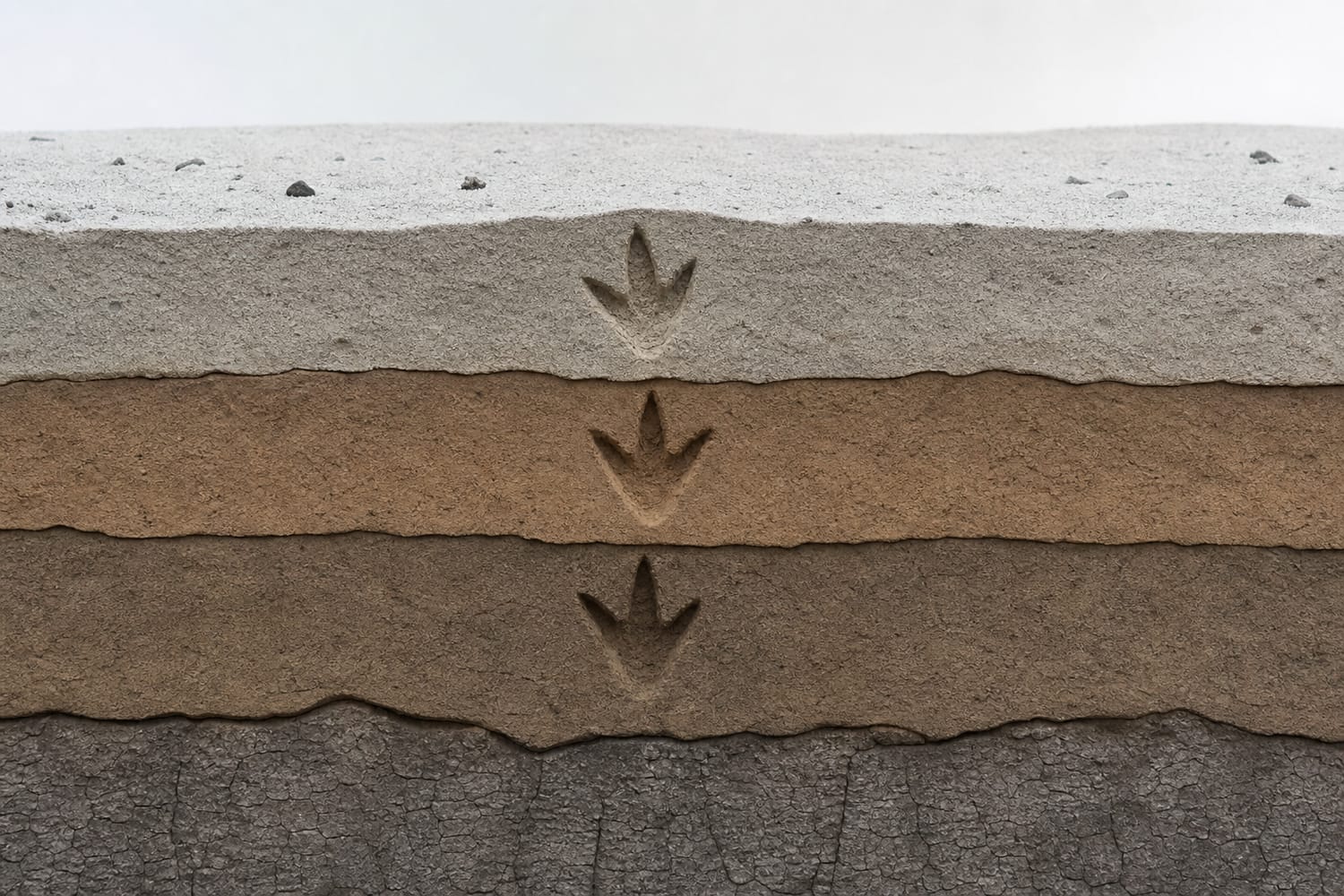
At Laetoli, a nearby volcano erupted and spread a layer of ash across the landscape. Rain turned the ash into a soft, cement-like surface. Animals walked across it, leaving impressions. Then more ash fell, covering and protecting the tracks. Over time, the layers hardened into rock.
A similar process can happen in mudflats, lake beds, riverbanks, dunes, or shorelines. The ground must be soft enough to record a print, but firm enough not to collapse. Then the impressions must be covered quickly before they are destroyed. Later, erosion may expose them again, allowing scientists to discover them.
This rare chain of events makes fossil footprints especially valuable. Bones tell us what bodies looked like. Tools tell us what hands could make. Footprints tell us how bodies moved through real landscapes.
What Ancient Footprints Reveal
A single footprint can contain a surprising amount of information. Scientists study its length, width, depth, toe impressions, stride length, spacing, and pressure patterns. From these details, they can estimate height, walking speed, gait, body weight, and sometimes even whether the walker was running, limping, carrying something, or moving in a group.
The Laetoli trackway appears to show multiple individuals walking across the same surface. Some researchers have suggested that one individual may have stepped partly in another’s footprints, making interpretation difficult. Still, the overall message is clear: these ancient hominins were competent upright walkers.
That matters because bipedalism is one of the defining traits of the human lineage. Walking on two legs freed the hands for carrying, gathering, tool use, and eventually more complex behaviors. The footprints do not show all of that directly, but they preserve a crucial foundation for everything that followed.
The Oldest Footprints of Homo sapiens
When people ask about the “oldest human footprints,” they often mean the oldest footprints made by Homo sapiens—people anatomically like us. For that category, South Africa has become especially important.
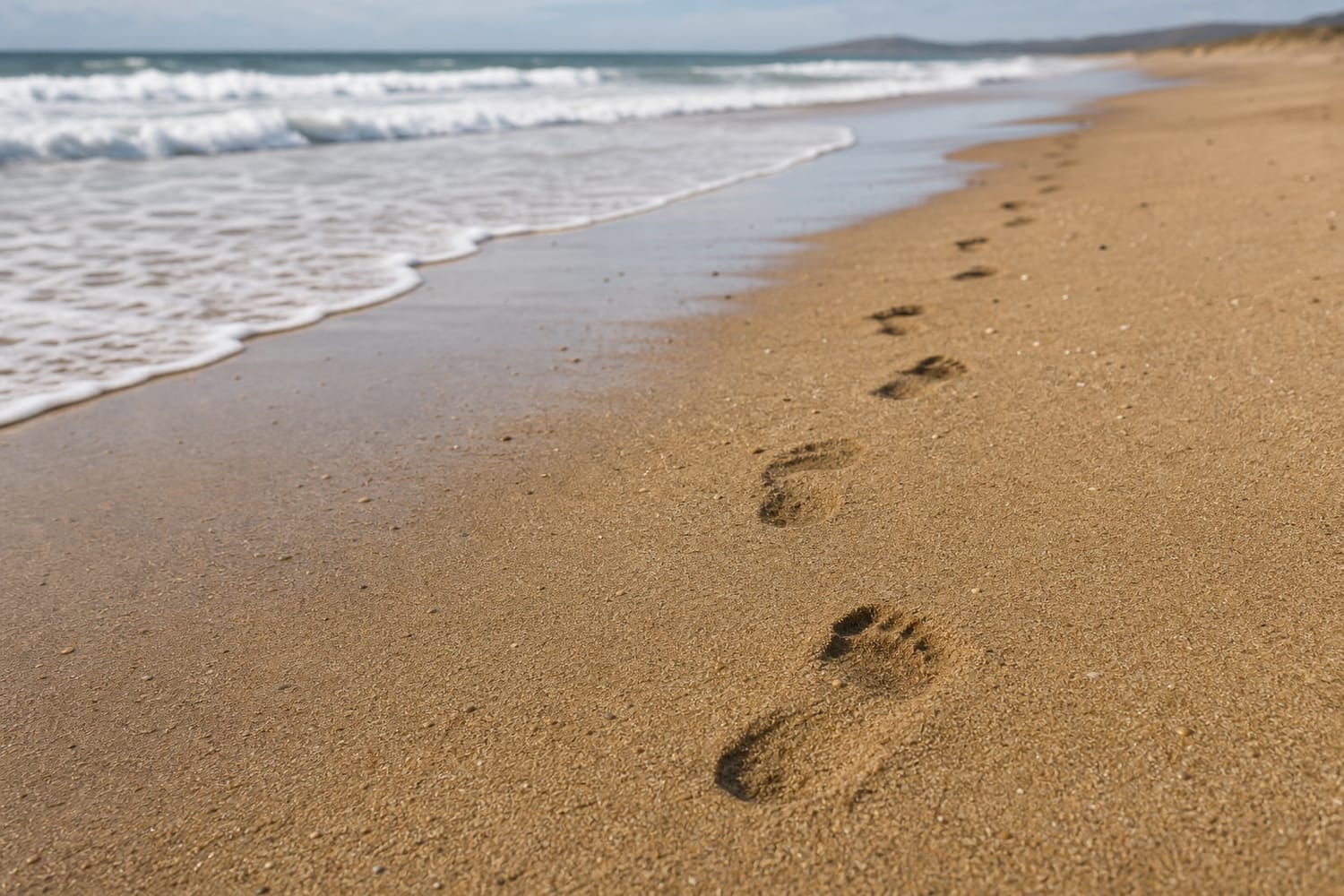
Along the Cape coast, researchers have identified ancient tracksites preserved in cemented sand dunes. Some have been dated to around 153,000 years ago, making them among the oldest known footprints attributed to our species. These prints were made during the Middle Stone Age, when Homo sapiens lived along rich coastal environments, gathering shellfish, making tools, and adapting to shifting climates.
Unlike the Laetoli footprints, these were made by humans who would have looked much more like us. They may have walked along beaches, dunes, or wet sand near the sea. The setting is easy to imagine: wind, surf, seabirds, and people moving across a coastal landscape long before recorded history.
These prints remind us that Homo sapiens had deep roots in Africa long before humans expanded across the globe.
White Sands and the Peopling of the Americas
Another record-breaking footprint discovery comes from White Sands National Park in New Mexico. There, researchers uncovered human footprints preserved in ancient lakebed sediments. The prints have been dated to around 21,000 to 23,000 years ago, though the dating has sparked scientific debate and further testing.
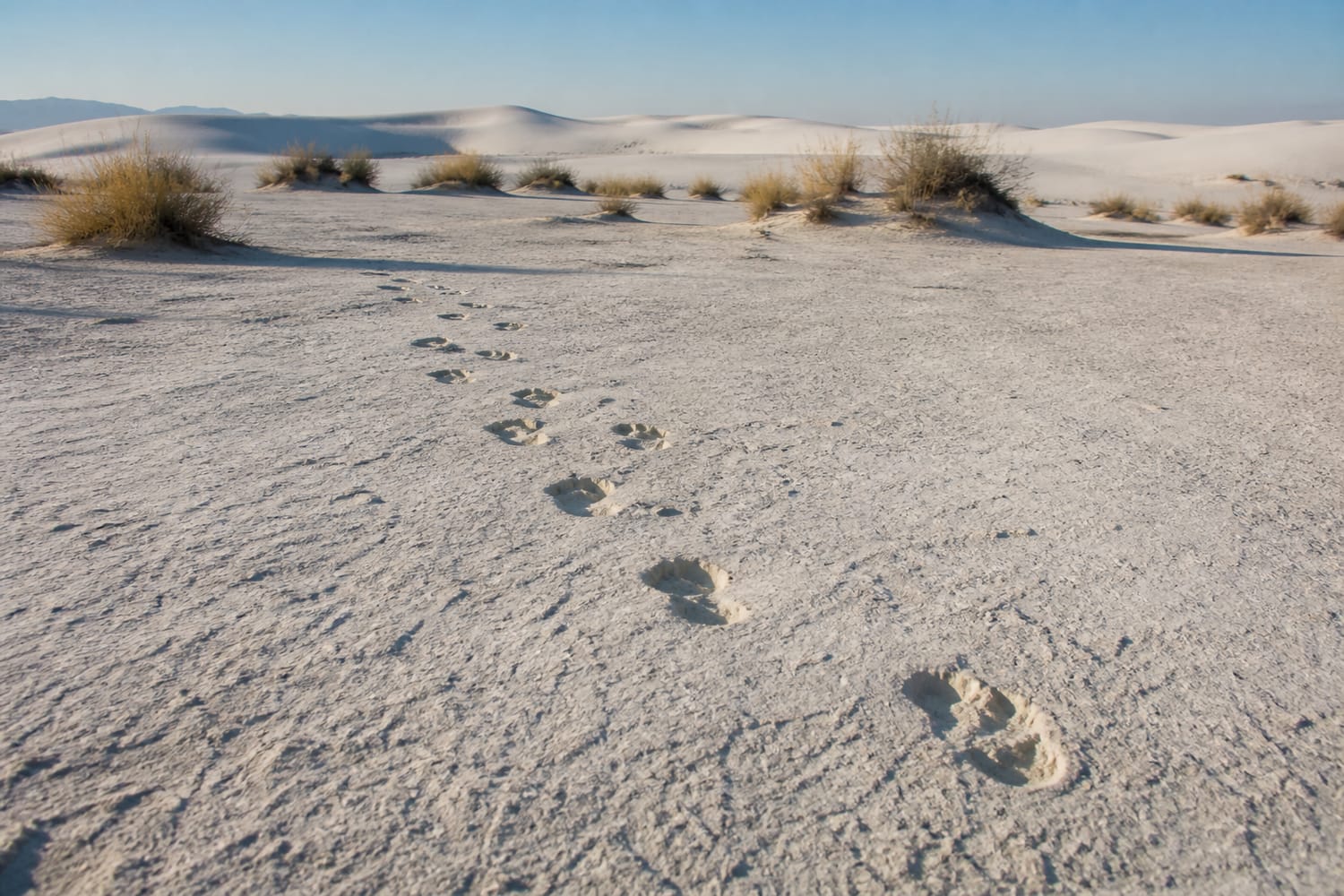
If the dates are correct, the White Sands footprints push human presence in the Americas back to the height of the last Ice Age. That is significant because, for decades, many archaeologists believed people arrived in the Americas only after ice sheets began retreating, roughly 13,000 to 16,000 years ago.
The White Sands trackways include footprints of adults and children. Some paths suggest repeated movement across a wetland landscape populated by mammoths, giant ground sloths, camels, and other Ice Age animals. In one especially vivid case, researchers described a long trackway that may have been made by a person carrying a child, with small child footprints appearing intermittently along the route.
These are not the oldest human footprints in the world, but they may be among the oldest direct evidence of humans in the Americas.
Why Footprints Feel So Personal
There is something emotionally powerful about footprints. A skull can seem distant. A stone tool can feel abstract. But a footprint is instantly recognizable. We understand the action because we do it every day.
When we look at fossil footprints, we are not just seeing anatomy. We are seeing movement. Someone passed through a place, perhaps without any idea that their steps would outlast mountains, rivers, and civilizations. They were going somewhere: across ash, through mud, along a shore, beside a lake. They may have been searching for food, following others, avoiding danger, or simply moving through the day.
That ordinary quality is what makes the discovery extraordinary. Ancient footprints turn prehistory from a timeline into a lived experience.
A Record Written in the Ground
The oldest footprints are more than curiosities. They are records of transformation: from ape-like ancestors walking upright in East Africa, to early Homo sapiens moving through coastal landscapes, to Ice Age people crossing the Americas.
Each trackway adds a few more steps to the story of us. The Laetoli footprints show that upright walking was established millions of years before modern humans appeared. The South African prints reveal our own species moving through ancient environments more than 150,000 years ago. The White Sands footprints capture human lives in a changing Ice Age world.
In the end, these discoveries remind us that history did not begin with writing, farming, or cities. It began with bodies moving through landscapes, one step after another. And in a few rare places, the Earth remembered.