Stanley Kubrick’s The Shining is remembered for many things: the blood pouring from the elevator, the eerie twins in the hallway, Jack Nicholson’s unhinged grin through a splintered door, and the Overlook Hotel’s impossible geography. But behind the film’s polished terror lies one of the most infamous production stories in movie history: a scene reportedly shot so many times that it entered legend as one of the most retaken scenes ever filmed.
The scene in question is the staircase confrontation between Wendy Torrance, played by Shelley Duvall, and Jack Torrance, played by Jack Nicholson. Wendy backs up the stairs, gripping a baseball bat, as Jack advances toward her with a mixture of mockery, menace, and madness. It is painful to watch because it feels so raw. Wendy is terrified, exhausted, and barely holding herself together.
That emotional realism was not accidental. According to widely circulated accounts, Kubrick filmed the scene 127 times, a staggering number that has often been cited as a record for a scene with dialogue. Whether discussed as a Guinness-worthy achievement, an example of perfectionist filmmaking, or a troubling case of directorial cruelty, the staircase sequence has become inseparable from the mythology of The Shining.
The Scene That Would Not End
The staircase scene arrives at a crucial point in The Shining. Wendy has discovered that Jack’s writing project consists only of the repeated phrase, “All work and no play makes Jack a dull boy.” The discovery confirms what she has feared: Jack is no longer merely angry or unstable. He is dangerous.
When Jack catches her looking at the manuscript, the confrontation begins. Nicholson’s performance is theatrical and predatory. He mocks Wendy’s panic, imitates concern, and twists ordinary conversation into psychological torture. Duvall’s Wendy retreats up the stairs, crying, pleading, and holding the bat as her only defense.
On paper, the scene is simple: two actors, one staircase, rising tension. In practice, it became a marathon. Every movement had to line up. Every emotional beat had to escalate. Wendy had to appear terrified but not passive; Jack had to seem deranged but still in control of the intimidation. The camera had to move with them, tracking the uneasy rhythm of retreat and pursuit.
Kubrick was known for demanding take after take, searching for something beyond technical correctness. He wanted the scene to feel unstable, as though the audience were trapped in the same nightmare as Wendy. By the time the final version was captured, the exhaustion visible in Duvall’s face was not just acting. It was the residue of a grueling process.
Kubrick’s Obsession With Repetition
Stanley Kubrick’s reputation as a perfectionist is almost as famous as his films. He was not a director who simply covered a scene from multiple angles and moved on. He explored scenes through repetition, sometimes asking actors to perform dozens upon dozens of takes.

To Kubrick, repetition could strip away habits. Actors might arrive with a prepared idea of how to play a scene, but after enough takes, that preparation began to collapse. What remained could be stranger, more spontaneous, or more psychologically exposed. In a horror film like The Shining, this method could produce extraordinary results.
But it also came at a cost. Repetition can sharpen a performance, but it can also drain the performer. A line spoken five times may feel flexible; a line spoken fifty times may become mechanical; a line spoken more than one hundred times can push an actor into frustration, fatigue, and emotional vulnerability.
Kubrick seemed willing to use that pressure. His films often have a chilly precision, as if every frame has been calculated. Yet the performances inside those frames can feel unpredictable and frayed. In The Shining, that combination is especially powerful: an immaculate visual world filled with people falling apart.
Shelley Duvall’s Exhausting Performance
No discussion of the staircase scene can avoid Shelley Duvall. Her performance as Wendy Torrance has been reassessed over time. Early critics sometimes dismissed Wendy as shrill or weak, but modern viewers are more likely to see Duvall’s work as the emotional core of the film. She portrays a woman trapped in an isolated hotel with an abusive husband, trying to protect her son while her reality collapses.
The filming process, however, was notoriously difficult for her. Duvall later spoke about the emotional strain of making The Shining, describing long days of crying, panic, and tension. The staircase scene represents that strain in concentrated form. Wendy’s trembling voice, frantic eyes, and desperate movements all feel uncomfortably authentic.
Kubrick’s treatment of Duvall has been widely debated. Some defend his methods as part of a demanding artistic process. Others argue that the production crossed a line, subjecting an actor to unnecessary distress in pursuit of realism. The famous behind-the-scenes documentary shot by Kubrick’s daughter, Vivian Kubrick, helped cement this perception, showing moments of tension between director and star.
What is clear is that Duvall gave a physically and emotionally demanding performance. The terror she communicates in the staircase sequence is not glamorous horror-movie screaming. It is messy, human panic. That is part of why the scene endures.
Jack Nicholson’s Controlled Madness
While Duvall’s exhaustion has become central to the legend, Jack Nicholson’s role in the scene is equally important. Nicholson was already known for his intensity, and his performance as Jack Torrance walks a strange line between dark comedy and genuine threat.
In the staircase scene, he does not simply charge at Wendy. He toys with her. He leans into sarcasm, twisting his face into exaggerated expressions and stretching his voice into cruel rhythms. His Jack is terrifying because he seems to enjoy the performance of being terrifying.
Nicholson’s theatricality contrasts with Duvall’s raw fear. That imbalance gives the scene its power. Wendy is reacting as if her life is truly in danger, while Jack behaves as though he is acting in a private play only he understands. The more he jokes, the more frightening he becomes.
Repeating the scene over and over may have amplified this dynamic. Nicholson, who was known for stamina and confidence, could keep experimenting with menace. Duvall, under the pressure of repeated takes, appeared increasingly fragile. Whether intentional or not, the production conditions echoed the characters’ relationship: Jack advancing, Wendy enduring.
The Record and the Myth
The exact “most retakes ever” claim can be tricky because film history is full of disputed production legends. Some accounts identify the staircase scene’s 127 takes as a record, particularly for a dialogue scene. Other stories about The Shining mention even higher numbers for other moments, including scenes involving Scatman Crothers, who played Dick Hallorann.
Still, the 127-take staircase sequence remains the most famous example. It has become shorthand for Kubrick’s relentless style and for the extreme demands placed on the cast. Whether one treats the number as a precise record or as part of Hollywood folklore, the story captures something true about the production: The Shining was made through obsessive repetition.
The legend persists because it is easy to see the evidence onscreen. The scene feels worn down to the nerve. It does not look like a polished performance delivered comfortably on an efficient set. It looks like something extracted through pressure.
That is why the record matters less as trivia than as context. Knowing the scene may have taken 127 takes changes the way viewers experience it. The fear becomes layered: Wendy is afraid of Jack, Duvall is surviving the demands of the role, and the audience senses both realities at once.
What the Retakes Added to the Film
It is fair to ask whether so many takes were necessary. Could Kubrick have achieved the same effect with fewer attempts? Possibly. Great directors often capture extraordinary performances without pushing actors to extremes. But in the case of The Shining, the staircase scene’s final form is undeniably powerful.
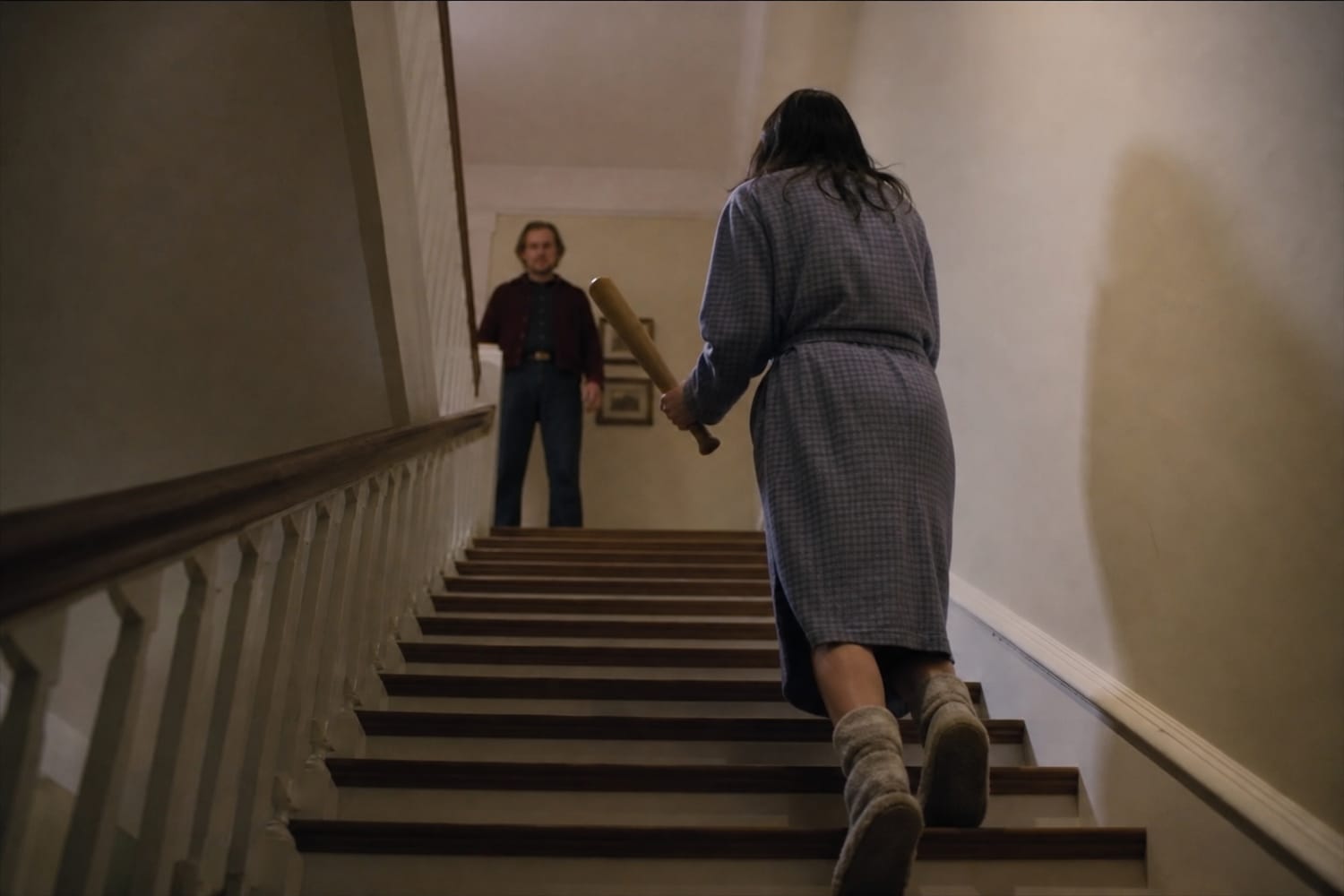
The pacing is strange and hypnotic. Jack’s slow advance feels unbearable because it refuses to resolve quickly. Wendy’s backward climb makes the space feel like a trap. The bat, usually a symbol of force, looks awkward and insufficient in her hands. The scene turns a domestic argument into a ritual of psychological domination.
The retakes likely contributed to the scene’s jagged emotional texture. Duvall does not appear to be performing fear in a clean, controlled way. She seems depleted by it. Nicholson’s Jack, meanwhile, seems energized by her terror. The result is not just suspense but discomfort.
That discomfort is central to The Shining. The film is not frightening only because of ghosts or murder. It is frightening because it captures the horror of being trapped with someone whose moods have become dangerous and unpredictable.
The Cost of Perfection
The staircase scene forces a larger question about filmmaking: when does artistic perfection become exploitation? Kubrick’s defenders point to the enduring brilliance of the result. His critics point to the human cost behind it.
Both views can exist at once. The Shining is a masterpiece of horror cinema, and Shelley Duvall’s performance is essential to that greatness. At the same time, admiration for the film does not require ignoring the difficulty of its creation. In fact, understanding that difficulty can deepen appreciation for the actor at the center of it.
Today, conversations about film production often include more attention to actor safety, mental health, and ethical direction. The mythology of the tortured set is no longer accepted as easily as it once was. The story of The Shining remains fascinating partly because it sits at the intersection of genius and discomfort.
Why the Scene Still Haunts Viewers
Decades later, the staircase confrontation remains one of the most unsettling scenes in horror. It contains no monster, no special effect, and no sudden shock. Its terror comes from performance, space, repetition, and emotional exposure.
The record-breaking number of takes has become part of the scene’s identity, but the reason people remember it is simpler: it feels real in a way that is hard to shake. Wendy’s panic, Jack’s cruelty, and the endless climb up the stairs create a nightmare of helplessness.
Kubrick’s obsession produced one of cinema’s most unforgettable moments. But the legacy of that obsession is complicated. The staircase scene stands as both a triumph of filmmaking and a reminder that some iconic images come with shadows behind the camera.
That tension is exactly why the story endures. Like the Overlook Hotel itself, the scene is beautiful, terrifying, and haunted by what happened inside it.