Echoes from the Ice Age
About 40,000 years ago, Ice Age people in Europe made flutes from bird bones and mammoth ivory. Although the fragile originals are not normally played today, accurate replicas produce clear musical notes. These artifacts are the oldest securely identified instruments with playable designs, revealing a surprisingly sophisticated prehistoric musical tradition.
The discovery changes how we imagine early humans. They were not merely surviving harsh climates, hunting animals, and seeking shelter. They were also craftspeople and musicians who invested time in creating instruments capable of melody.
The Flutes of the Swabian Jura
The most convincing evidence of music from 40,000 years ago comes from the Swabian Jura of southwestern Germany. Archaeologists working in caves including Geißenklösterle, Hohle Fels, and Vogelherd uncovered fragments of carefully manufactured flutes.
These sites belonged to the Aurignacian culture, associated in Europe with some of the earliest populations of Homo sapiens. The caves also contained carved animals, personal ornaments, tools, and other evidence of symbolic expression.
Flutes from Geißenklösterle have been dated to approximately 42,000 to 43,000 years ago. Other specimens from the region are generally described as roughly 35,000 to 40,000 years old. The University of Tübingen’s account of Ice Age musical discoveries notes that experimental reconstructions demonstrate that these instruments could genuinely be used to make music.
Turning Bones into Musical Instruments
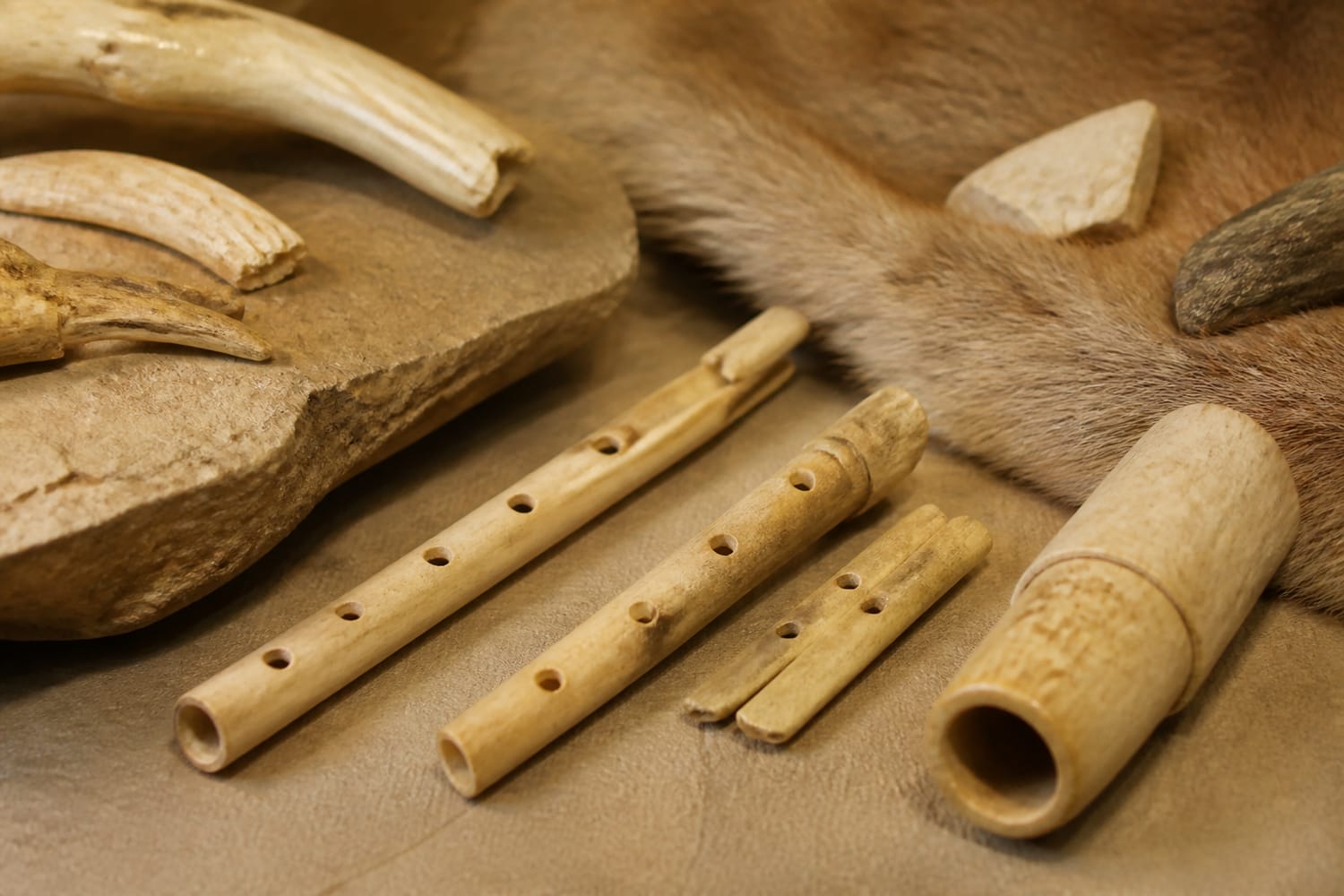
Bird bones were ideal for prehistoric flute makers because they are naturally hollow. The wing bones of swans and griffon vultures could be cleaned, shaped, and pierced with finger holes without requiring the maker to hollow out a solid object.
Producing a functional flute still demanded planning and precision. A craftsperson had to select a suitable bone, remove unwanted material, smooth the surface, create evenly positioned holes, and shape an edge over which air could be directed.
The surviving instruments and fragments include examples made from:
- Swan wing bones
- Griffon vulture bones
- Mammoth ivory
- Possibly cave bear bone
Mammoth ivory presented a greater technical challenge. Unlike a bird bone, an ivory tusk is solid. Makers had to split a section lengthwise, carve channels into both halves, and join the pieces to create an airtight tube. The existence of such instruments suggests that musical craftsmanship already included specialized knowledge passed between individuals or generations.
What Did the Ancient Flutes Sound Like?
No melody from the Paleolithic period was written down, so researchers cannot reproduce an actual Ice Age song. What they can reconstruct is the instrument’s voice.
Replicas demonstrate that the flutes can produce sustained tones and changes in pitch. By covering different finger holes and adjusting breath pressure, a musician can play sequences of recognizable notes. Depending on the reconstruction and playing technique, the sound may be airy and delicate or sharp enough to carry through a cave.
This is an important distinction: archaeologists generally avoid playing the original 40,000-year-old objects because they are incomplete, delicate, and culturally irreplaceable. When these flutes are called playable, the term usually means that their designs are acoustically functional and can be recreated successfully.
Modern performances on replicas do not reveal precisely what Paleolithic music sounded like. They demonstrate something equally significant: the original makers understood how to transform breath, material, and carefully spaced holes into controlled musical sound.
The Divje Babe Mystery
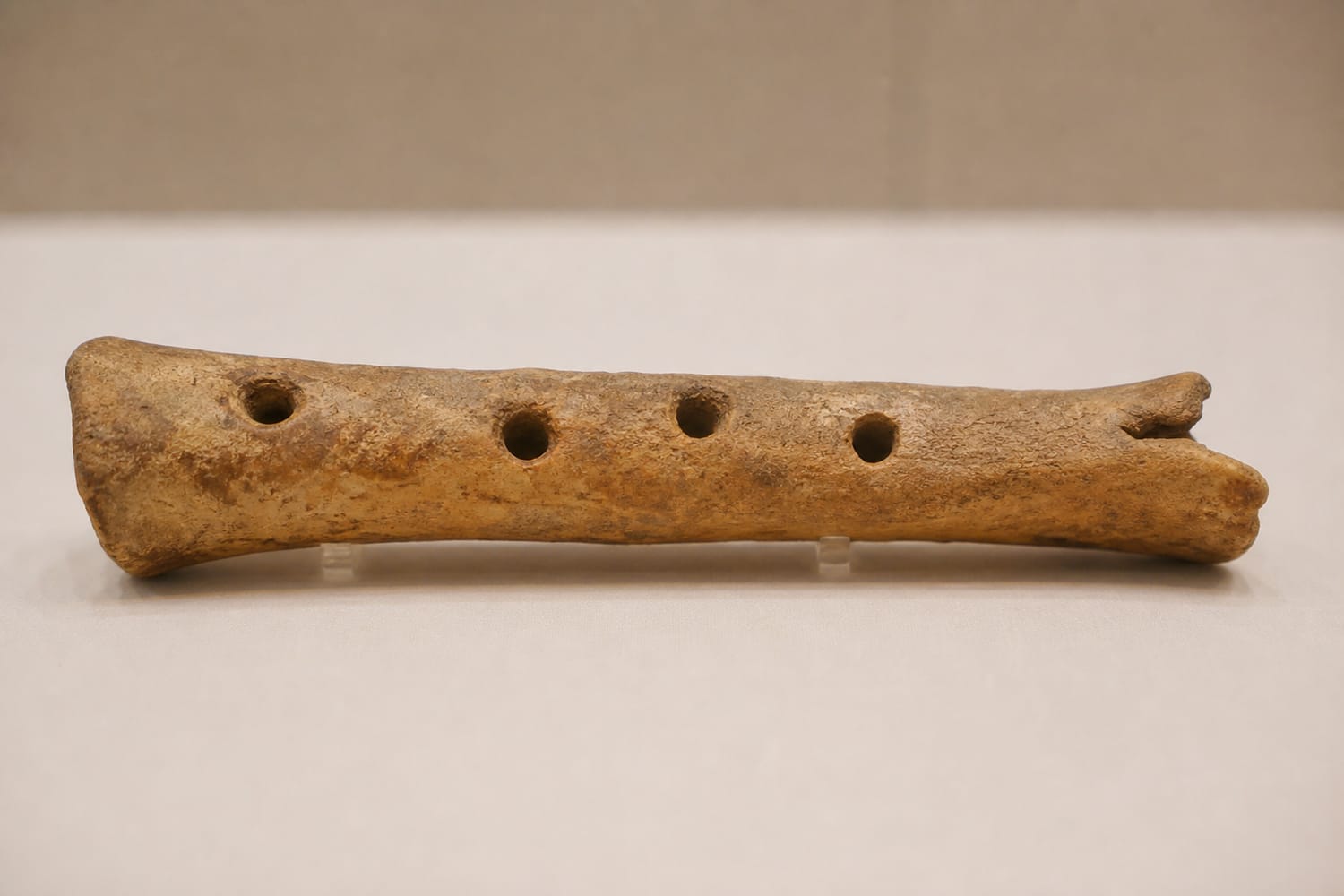
An even older candidate was discovered in Slovenia’s Divje Babe cave in 1995. The object is a fragment of a young cave bear’s thighbone containing several holes. Based on the surrounding archaeological layer, it may be between 50,000 and 60,000 years old.
The National Museum of Slovenia identifies the Divje Babe artifact as a Neanderthal-made musical instrument. Researchers supporting this interpretation point to the arrangement of its holes, possible mouthpiece, tool marks, and successful playable reconstructions.
However, the identification remains debated. Some scholars have argued that carnivore teeth or other natural processes might have punctured the bone. If intentional manufacture is conclusively established, it would push instrumental music back thousands of years and show that Neanderthals also created complex musical tools.
Because of this controversy, the German bird-bone and ivory flutes are usually treated as the oldest widely accepted purpose-built musical instruments.
Playable Originals Versus Playable Reconstructions
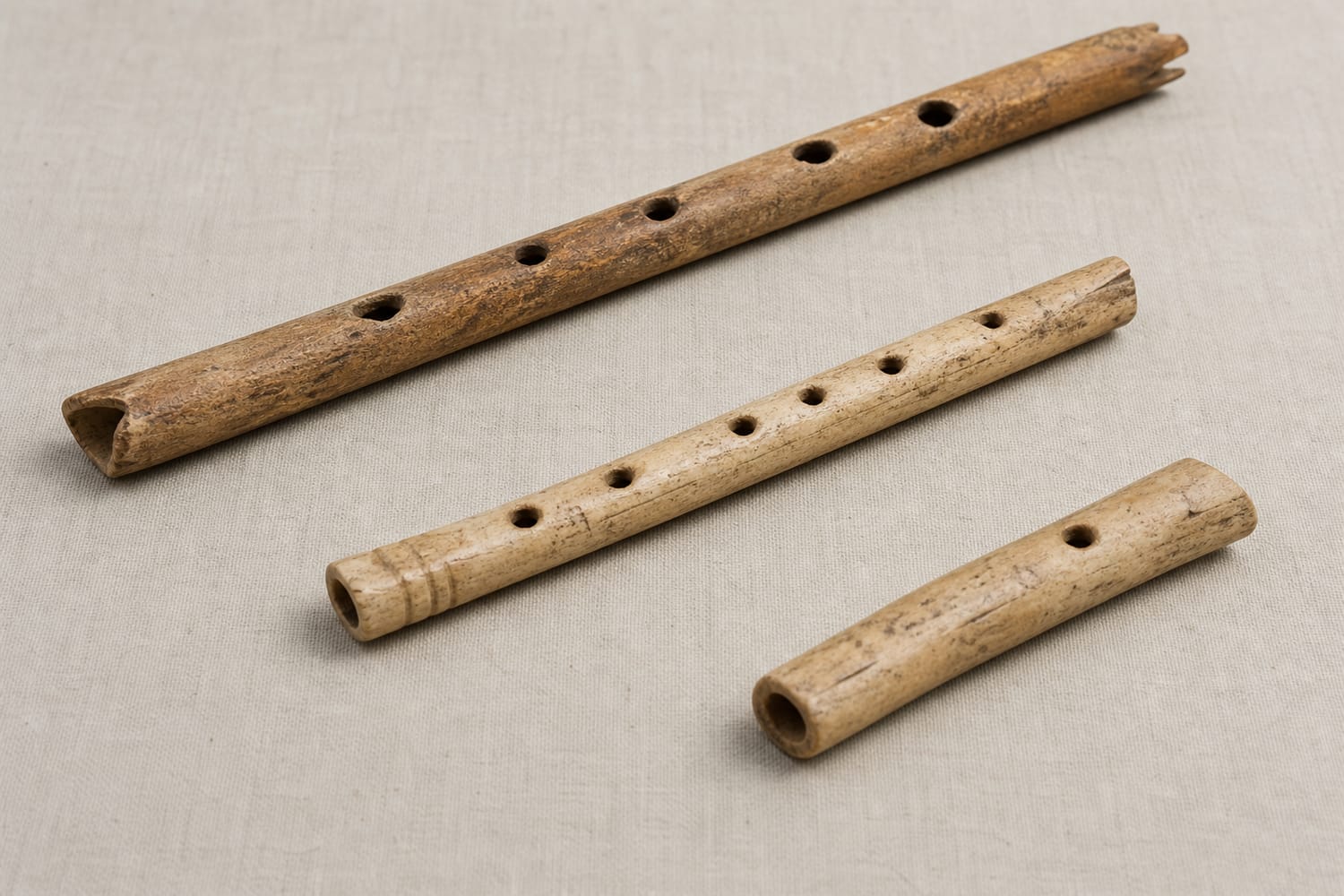
Another distinction appears in discussions of the Jiahu bone flutes from Neolithic China. These crane-bone instruments are only about 8,000 to 9,000 years old, making them far younger than the Ice Age flutes. Yet several survived in remarkably complete condition and are often described as the oldest playable original musical instruments.
The Metropolitan Museum of Art’s overview of Jiahu explains that six examples represent some of the earliest complete playable instruments found. They possess carefully drilled holes and provide clear evidence of organized pitch systems.
The categories can therefore be summarized as follows:
- Oldest widely accepted musical instrument designs: European Paleolithic flutes dating back roughly 40,000 years
- Possible oldest instrument: The debated Divje Babe bone, potentially 50,000 to 60,000 years old
- Oldest complete playable originals: Jiahu crane-bone flutes, approximately 8,000 to 9,000 years old
Recognizing these definitions prevents the word “playable” from creating a misleading comparison.
Why Music Mattered 40,000 Years Ago
A flute requires more effort than an improvised whistle. Its maker must understand how the length of a tube, the placement of holes, and the direction of airflow affect sound. That investment suggests music held meaningful social value.
Flutes may have accompanied dancing, rituals, storytelling, courtship, mourning, or communal gatherings. Music could also have strengthened cooperation by allowing groups to synchronize movement and share emotional experiences.
The exact purpose remains unknown, but the instruments show that prehistoric communities valued organized sound. Their interest in musical experimentation eventually produced everything from percussion traditions to the many unusual instruments created throughout history. Rhythm was probably even older than the surviving flutes, although early drums made from wood, hide, or plant material would rarely survive for archaeologists to discover. The enduring importance of percussion can still be seen in achievements such as the record-breaking tradition of extended drum performances.
A Human Voice Preserved in Bone and Ivory
The oldest flutes are extraordinary because they narrow the emotional distance between modern people and their Paleolithic ancestors. Their makers possessed imagination, patience, manual skill, and a desire to create sounds that went beyond ordinary speech.
We may never know the melodies performed beside Ice Age fires. Nevertheless, playable reconstructions let us hear the tonal possibilities available to musicians tens of thousands of years ago.
A few fragments of bone and ivory have preserved more than an ancient technology. They offer evidence that music was already part of human identity near the beginning of our documented cultural story—a way to communicate, gather, remember, and transform breath into something beautiful.