The Super Bowl halftime show has become much more than a break between two halves of football. For many viewers, it is the main event: a 12-to-15-minute spectacle where music, fashion, choreography, technology, and celebrity culture collide in front of one of the largest television audiences of the year. Over time, certain performances have done more than entertain. They have broken ratings records, sparked viral moments, revived catalogs, changed how artists approach live performance, and become permanent fixtures in pop culture memory.
From Michael Jackson turning halftime into a global concert event to Rihanna revealing her pregnancy on one of the world’s biggest stages, the Super Bowl halftime show has repeatedly created moments that outlived the game itself. These are the performances that didn’t just make headlines—they reshaped the entertainment industry.
Michael Jackson Made Halftime a Must-Watch Event
Before Michael Jackson’s 1993 Super Bowl halftime show, the mid-game entertainment was often treated as filler. Marching bands, themed productions, and family-friendly variety acts were common, but the performance was not necessarily a cultural destination. Jackson changed that instantly.
At Super Bowl XXVII, he stood motionless on stage for more than a minute as the crowd roared. It was a bold, theatrical move that only an artist with his level of command could pull off. His set included hits like “Jam,” “Billie Jean,” “Black or White,” and “Heal the World,” combining stadium-scale spectacle with a message of unity.
The most important record Jackson broke was not simply numerical—it was structural. His performance reportedly helped keep viewers from changing the channel during halftime, proving that the show could be as valuable as the game. After Jackson, the NFL increasingly pursued major pop stars, and halftime became a coveted career milestone.
Diana Ross Took the Exit to New Heights
Diana Ross’s 1996 halftime show is remembered for one of the most dramatic exits in live television history. After performing a medley of Supremes classics and solo hits, Ross ended the show by climbing into a helicopter and flying out of the stadium.
It was pure diva spectacle: glamorous, slightly surreal, and perfectly suited to the larger-than-life nature of the Super Bowl. While modern halftime shows often rely on digital screens, drones, and complicated stage mechanics, Ross proved that a single unforgettable visual could define an entire performance.
Her show helped establish the idea that halftime was not just about singing hit songs. It was about staging a moment people would talk about the next day. In that sense, Ross helped set the template for the viral halftime era before social media even existed.
U2 Turned Halftime Into a National Memorial
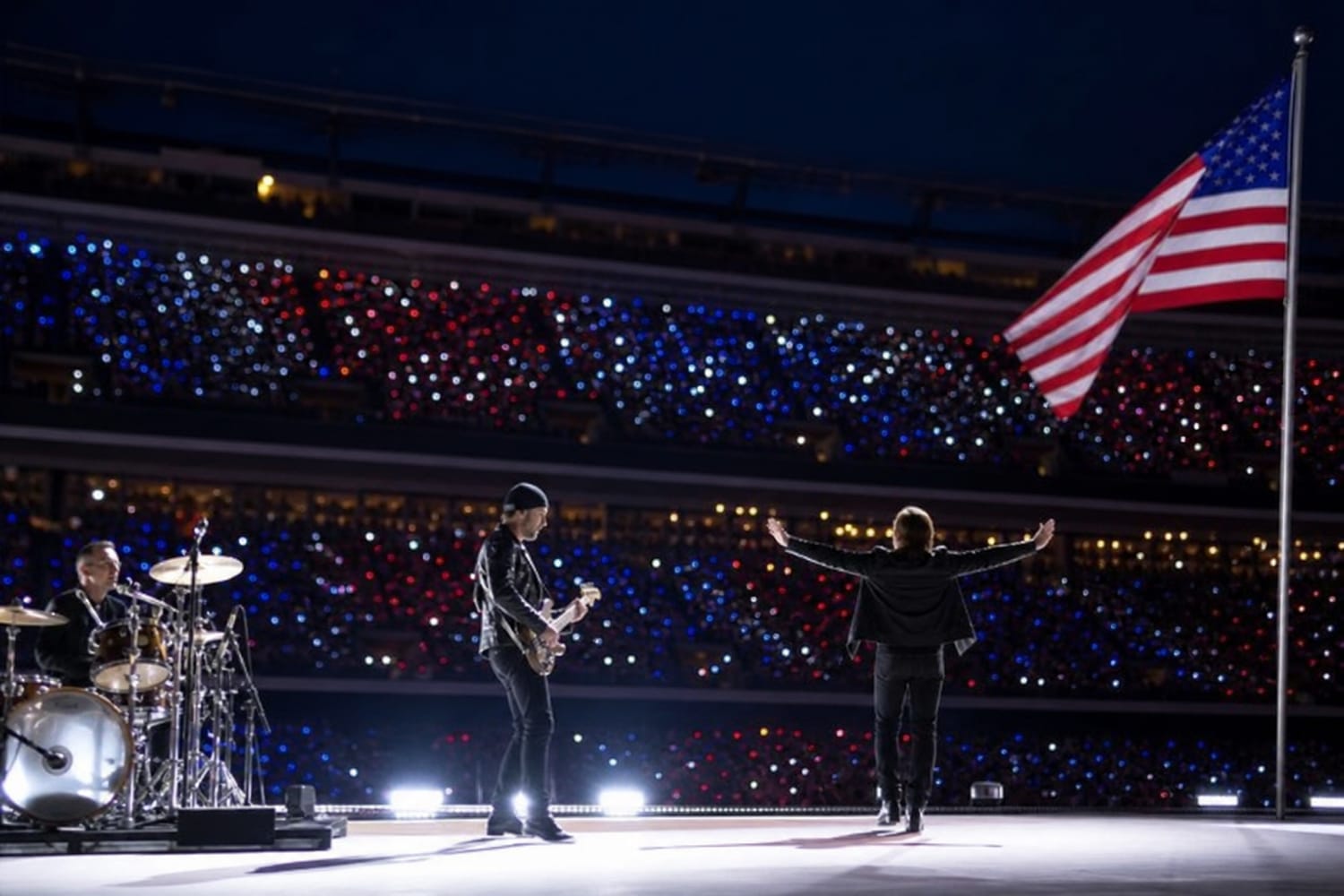
U2’s 2002 halftime performance came just months after the September 11 attacks, and the band understood the emotional weight of the moment. Instead of treating the show as a typical promotional opportunity, they transformed it into a tribute.
As U2 performed “Where the Streets Have No Name,” the names of 9/11 victims scrolled upward on a massive screen behind them. Bono opened his jacket at the end to reveal the American flag lining inside. It was simple, solemn, and deeply affecting.
This performance broke a different kind of pop culture record: it showed that the halftime show could carry national grief and collective healing. It remains one of the most respected Super Bowl performances because it balanced spectacle with sincerity. In a setting known for excess, U2 delivered emotional restraint—and that made it unforgettable.
Prince Created the Gold Standard
Prince’s 2007 halftime show is often called the greatest Super Bowl halftime performance of all time. The reason is not just the setlist, though it was packed with classics and covers. It was the setting: a Miami rainstorm that could have ruined the show but instead made it legendary.
When Prince performed “Purple Rain” in the actual rain, the moment felt almost too perfect to be real. The lighting, the guitar solo, the silhouette behind the flowing sheet, and the weather all combined into a scene that looked mythic. Rather than being overwhelmed by the conditions, Prince seemed to command them.
This performance broke the standard for what a live televised concert could achieve. It showed that technical perfection was not always the goal. Sometimes the greatest pop culture moments come from unpredictability, risk, and an artist fully owning the stage.
Madonna Proved Pop Royalty Still Ruled
Madonna’s 2012 halftime show was a massive statement from one of pop’s most influential figures. Entering the field like a modern Cleopatra, she delivered a highly choreographed production featuring “Vogue,” “Music,” “Like a Prayer,” and guest appearances from LMFAO, Nicki Minaj, M.I.A., and CeeLo Green.
At the time, Madonna’s performance became one of the most-watched halftime shows ever, drawing more viewers than the game itself. That achievement reinforced the growing truth that halftime could rival football in cultural importance.
The show also sparked controversy when M.I.A. made an obscene gesture on camera, leading to years of legal fallout. In classic Madonna fashion, the performance generated both admiration and debate. It proved that even decades into her career, she could still dominate the pop culture conversation.
Beyoncé Redefined Halftime Power
Beyoncé’s 2013 halftime show was a masterclass in precision, charisma, and star power. Opening with “Love on Top” and moving through hits like “Crazy in Love,” “End of Time,” and “Halo,” she delivered a performance that felt both athletic and effortless.
The reunion with Kelly Rowland and Michelle Williams of Destiny’s Child created one of the night’s biggest nostalgia moments. The trio performed “Bootylicious,” “Independent Women Part I,” and joined Beyoncé for “Single Ladies,” sending fans into a frenzy.
Shortly after the performance, a power outage delayed the game, which fueled jokes and memes about Beyoncé being so powerful she “shut down the Super Bowl.” While she did not actually cause the blackout, the association became part of the performance’s mythology. Beyoncé turned halftime into a demonstration of dominance: vocally, physically, and culturally.
Katy Perry Launched the Meme Era
Katy Perry’s 2015 halftime show was colorful, campy, and packed with visual hooks. She entered riding a giant mechanical lion, performed hits like “Roar,” “Dark Horse,” “Teenage Dream,” and “Firework,” and brought out Lenny Kravitz and Missy Elliott.
But the show’s most unexpected star was Left Shark, one of the costumed backup dancers during “Teenage Dream” and “California Gurls.” The shark’s awkward, off-beat dancing became an instant meme, spreading across social media faster than almost anything else from the broadcast.
Perry’s performance became one of the most-watched halftime shows in history, and it demonstrated how the internet had changed the stakes. A halftime show no longer ended when the broadcast cut back to football. It continued through GIFs, memes, reaction posts, and viral clips. Left Shark proved that even a background dancer could become a pop culture icon overnight.
Lady Gaga Took Flight
Lady Gaga’s 2017 halftime show began with a cinematic rooftop sequence before she appeared to leap into the stadium, supported by wires, as drones lit up the sky behind her. The entrance alone became one of the most memorable in halftime history.
Her set included “Poker Face,” “Born This Way,” “Telephone,” “Just Dance,” “Million Reasons,” and “Bad Romance.” Gaga blended theatricality with live vocals and intense choreography, reminding audiences of her reputation as one of pop’s most committed performers.
The show generated major sales and streaming boosts for her music, a recurring halftime effect that has become increasingly important in the digital era. Gaga’s performance broke through because it combined classic pop spectacle with modern technology, turning the entire stadium into a stage.
Shakira and Jennifer Lopez Celebrated Global Pop
The 2020 halftime show starring Shakira and Jennifer Lopez was a landmark for Latin pop representation on one of America’s biggest stages. The performance was fast, celebratory, and filled with cultural references, from salsa and champeta to reggaeton and Latin trap.
Shakira delivered viral moments with “She Wolf,” “Whenever, Wherever,” and her now-famous tongue trill, which quickly became a meme. Jennifer Lopez brought Vegas-level precision with “Jenny from the Block,” “Waiting for Tonight,” and “On the Floor.” Guest appearances by Bad Bunny, J Balvin, and Lopez’s daughter Emme added generational and global dimensions.
The show was widely discussed not only as entertainment but as a cultural statement. At a time of intense political debate around immigration and identity, Shakira and Lopez used the halftime stage to celebrate Latinidad, bilingual music, and global pop power.
Rihanna Broke the Internet Without Moving Much
Rihanna’s 2023 halftime show was highly anticipated because it marked her return to live performance after years away from the stage. Rather than relying on surprise guests or complicated choreography, she commanded attention with calm confidence, performing on floating platforms while dressed in red.
The biggest revelation came when viewers realized she was pregnant with her second child. The announcement instantly became one of the most talked-about celebrity moments of the year. In a single performance, Rihanna turned the halftime show into a pregnancy reveal, a fashion statement, and a career-spanning celebration.
Her setlist included “Bitch Better Have My Money,” “Where Have You Been,” “Only Girl (In the World),” “We Found Love,” “Work,” “Umbrella,” and “Diamonds.” The performance drew massive viewership and streaming attention, reinforcing Rihanna’s rare ability to dominate pop culture even without releasing a new album.
Usher Set a New Viewership Benchmark
Usher’s 2024 halftime show brought R&B showmanship back to the center of the Super Bowl. With roller-skating choreography, Vegas flair, and a packed list of guests including Alicia Keys, H.E.R., will.i.am, Lil Jon, Ludacris, and Jermaine Dupri, the performance celebrated decades of club, pop, and R&B hits.
Songs like “Caught Up,” “U Got It Bad,” “Love in This Club,” “OMG,” “Turn Down for What,” and “Yeah!” turned the stadium into a massive party. The performance reportedly became the most-watched Super Bowl halftime show ever, reflecting both Usher’s legacy and the enormous audience for Super Bowl LVIII.
His show proved that nostalgia, when executed with energy and precision, can be record-breaking. It also highlighted how halftime has become a multigenerational event, where parents, millennials, Gen Z viewers, and casual fans can all find a point of connection.
Why These Records Matter
Super Bowl halftime records are not just about ratings. They are about cultural impact. A great halftime show can revive an artist’s catalog, inspire memes, make political statements, introduce younger audiences to legacy performers, and create moments that are replayed for decades.
The artists who broke pop culture records did so by understanding the scale of the stage. Some delivered technical brilliance. Some created emotional resonance. Some sparked controversy. Some simply gave the internet an image it could not stop sharing.
That is why the halftime show remains one of entertainment’s most fascinating platforms. It is live, risky, compressed, and watched by millions who may not agree on music, football, or culture. When it works, it becomes more than a performance. It becomes history.