A message in a bottle is one of the simplest mysteries the sea can make. A hand writes a note, seals it in glass, and lets the ocean decide where it goes. Most vanish forever. Some wash ashore within weeks. A rare few cross impossible distances or wait for generations before being found.
The most famous record-breaking case is not a romantic love letter or a pirate-like treasure clue. It is a scientific message, dropped into the Indian Ocean in 1886 and discovered on a beach in Western Australia in 2018. After 131 years and 223 days, it became widely recognized as the oldest known message in a bottle ever found.
Its journey is a story of ocean currents, forgotten experiments, historical detective work, and the strange way the sea can preserve a secret for more than a century.
A Bottle Found in the Sand
In January 2018, Tonya Illman was walking on a remote beach near Wedge Island, north of Perth, Western Australia. Among the sand and coastal debris, she noticed an old-looking bottle partly buried in the dunes. At first, it seemed like an interesting decoration more than a historic artifact.
Inside was a tightly rolled piece of paper, damp but still intact. When the paper was carefully dried and unrolled, it revealed printed German text and handwritten details. The note was not a personal confession or a plea for help. It was a formal drift card, part of a 19th-century scientific experiment designed to study ocean currents.
The bottle had been thrown overboard from a German sailing ship named Paula on June 12, 1886. It was found on January 21, 2018. That made its known time between release and discovery more than 131 years.
For something as fragile as paper inside glass, the survival alone was astonishing.
The German Ocean Experiment
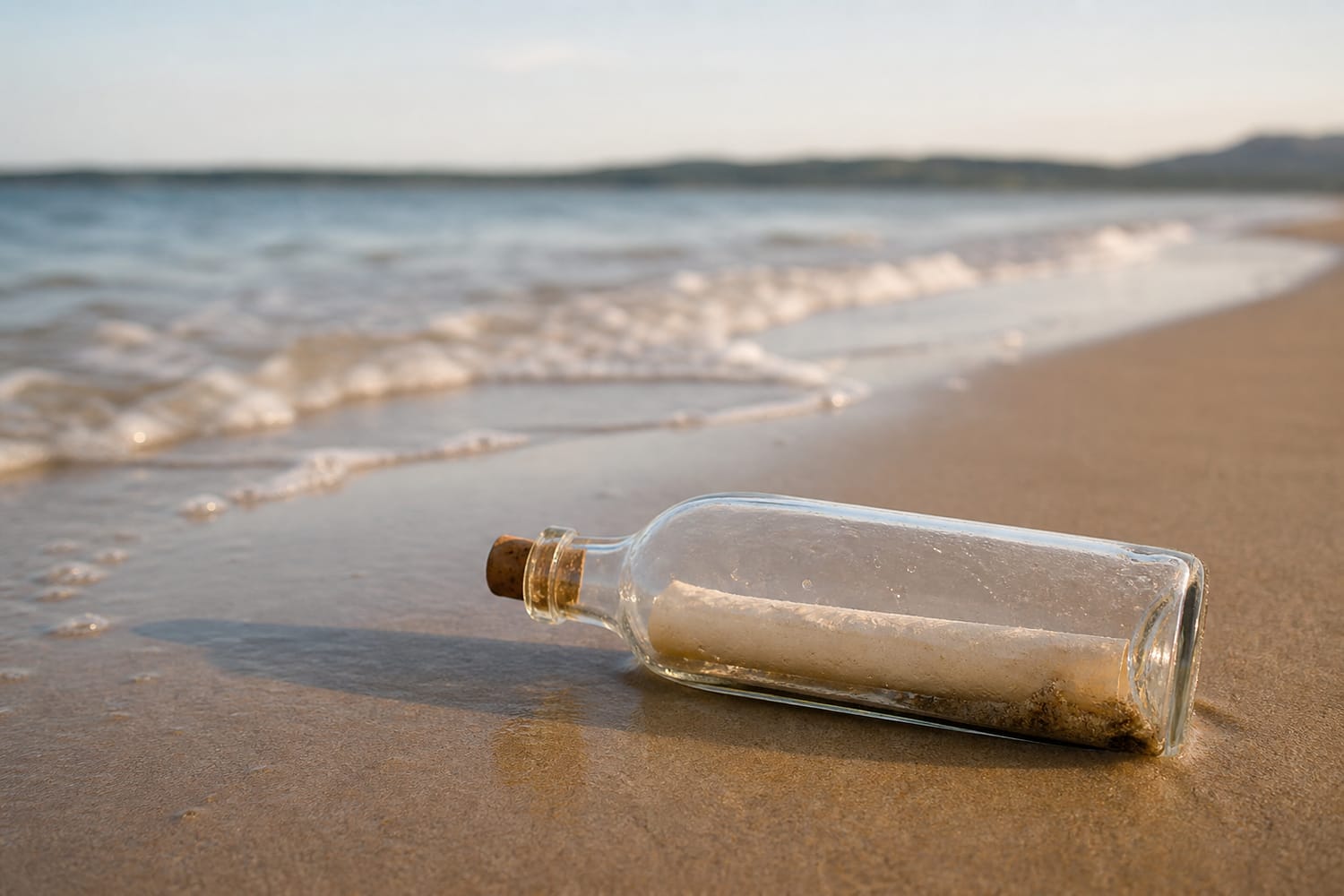
During the late 1800s, scientists were trying to understand how the world’s oceans moved. Today, oceanographers use satellites, floating sensors, GPS-tracked buoys, and computer models. In the 19th century, one practical method was much simpler: throw bottles into the sea and ask whoever found them to report where and when they were discovered.
The German Naval Observatory conducted a large-scale drift bottle program. Ships were given bottles containing printed slips. Each slip asked the finder to write where the bottle was found and return the information to German authorities. The original crew would record the date, ship, and coordinates at which the bottle was released.
The bottle found near Wedge Island was one of thousands used in these experiments. The note inside included the ship’s name, the date, and its position in the Indian Ocean. It was not meant to become a mystery object in the 21st century. It was a data point.
But unlike most data points, this one took more than a lifetime to arrive.
The Ship Named Paula
The message was launched from the German barque Paula, a sailing vessel traveling through the Indian Ocean. Records showed that on June 12, 1886, the ship was at approximately 32 degrees south latitude and 105 degrees east longitude when the bottle was released.
That location lies in the eastern Indian Ocean, far from the Western Australian coast but within reach of the region’s powerful current systems. The bottle likely drifted eastward or northeastward over time, influenced by winds, waves, and currents. It may have washed ashore long before 2018 and then been buried by sand for decades.
This is one of the most intriguing parts of the story. The bottle probably did not float freely for 131 years. Glass can survive in the sea, but a bottle drifting for that long would face storms, collisions, biofouling, and countless chances to break or sink. More likely, it arrived on land years after release, became lodged in dunes, and waited there in silence.
In that sense, the “journey” was not only across the ocean. It was also a journey through time.
How the Message Was Verified
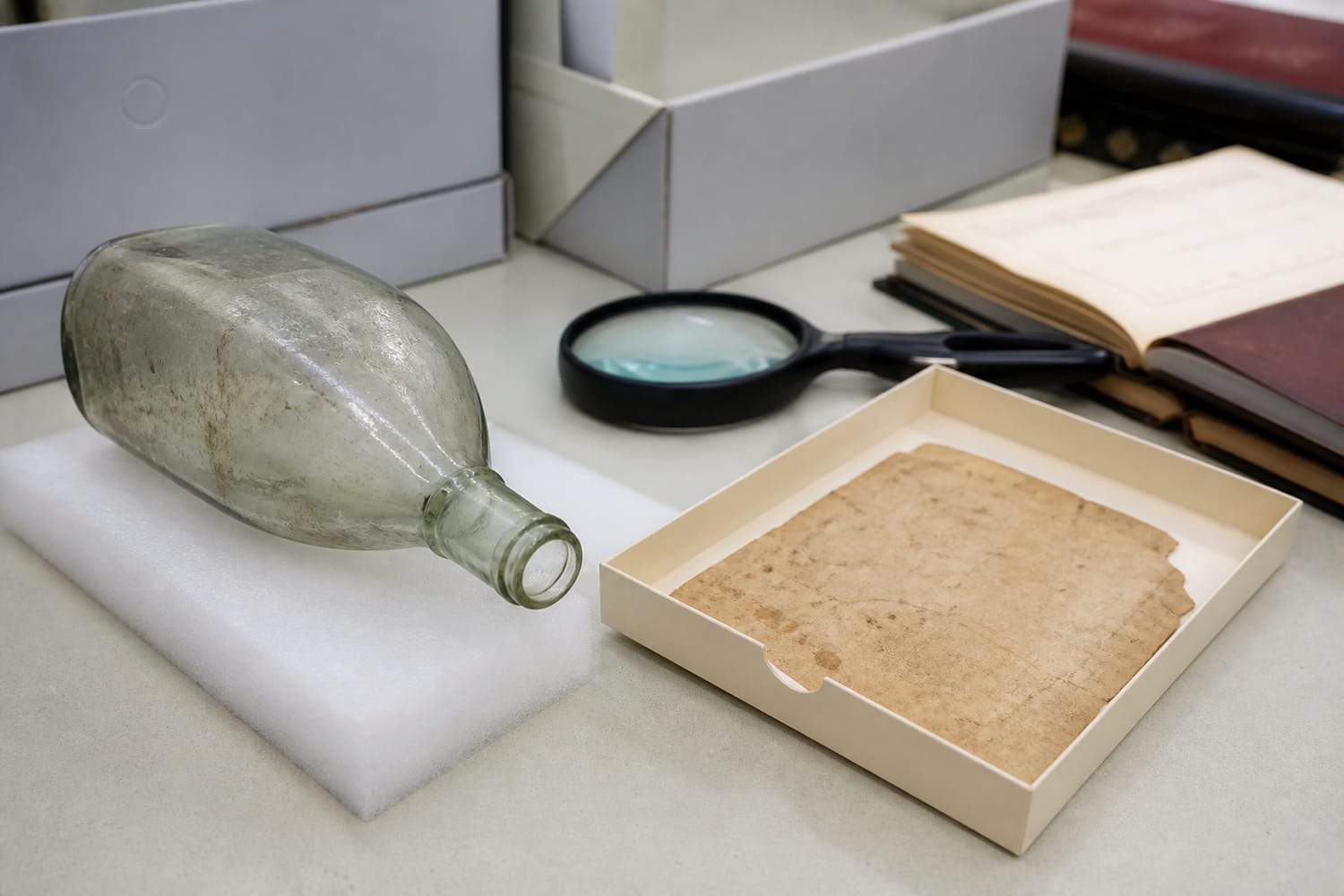
A discovery like this demands skepticism. Old bottles can be planted. Paper can be forged. Dates can be misread. To confirm the find, researchers and museum experts examined the bottle, the paper, and historical records.
The Western Australian Museum helped authenticate the artifact. Experts compared the bottle style with 19th-century manufacturing methods and studied the note’s paper, ink, and printing. The crucial evidence came from German maritime archives.
A ship’s log from the Paula confirmed that a drift bottle had been thrown overboard on the exact date and at the recorded location written on the note. Even the handwriting on the bottle slip matched entries in the ship’s meteorological journal.
That archival match transformed the object from a curious beach find into a verified historical record. It was not merely old; it was traceable.
The bottle broke the previous known record for the oldest message in a bottle, which had stood at just over 108 years. This find extended the record by more than two decades.
Why the Bottle Survived
The survival of the bottle depended on a chain of lucky conditions. First, the seal had to hold long enough to protect the paper from seawater. Many drift bottles were sealed with corks, sometimes strengthened with wax or other materials. If water entered early, the paper would have disintegrated.
Second, the bottle had to avoid being smashed. Shorelines are harsh places. Rocks, reefs, storms, and shifting sand can destroy glass quickly. The Wedge Island area includes sandy dunes, which may have helped cushion and preserve it.
Third, the paper had to survive changes in heat, humidity, and exposure. Once buried in sand, the bottle may have been protected from sunlight and physical disturbance. The dunes that hid it also helped preserve it.
The object endured because it was both lost and sheltered. Had it remained visible, it might have been broken, collected, or thrown away generations earlier.
What the Ocean Mystery Reveals
The record-breaking bottle is fascinating because it connects ordinary human curiosity with planetary forces. A ship’s crew followed scientific instructions, dropped a bottle into the sea, and moved on. More than a century later, someone walking a beach completed the experiment.
It reminds us that oceans are not empty spaces between continents. They are moving systems with patterns, pathways, and memory. Currents can carry objects across vast distances, but coastlines and sands can hold them in place like time capsules.
The story also shows the value of careful record keeping. Without the Paula’s logbook, the message might have remained an interesting but uncertain artifact. Because someone in 1886 wrote down the release, and because those records survived, modern researchers could solve the mystery.
A small bottle became a collaboration between sailors, scientists, archivists, museum experts, and a beachcomber separated by 131 years.
Other Remarkable Bottle Journeys
The Paula bottle is famous for age, but message-in-a-bottle stories have taken many forms. Some have crossed oceans in only months. Others have connected strangers across continents. A few have been used in scientific studies, while others carried personal notes from children, fishermen, soldiers, or travelers.
One reason these stories remain popular is their unpredictability. Unlike a letter with an address, a bottle has no planned recipient. Its destination is chosen by currents and chance. The finder becomes part of the story simply by noticing it.
Modern drift studies no longer depend on glass bottles, but the idea survives. Scientists use drifting buoys, floating tags, and GPS instruments to track currents, marine debris, and climate patterns. The principle is the same: release an object, follow its movement, and learn how the ocean behaves.
The 1886 bottle belongs to an earlier version of that same scientific tradition.
A Message From the Deep Past
The longest-known message in a bottle journey is not dramatic because of what the note says. Its words are practical and scientific. Its power comes from the distance between the moment it was released and the moment it was found.
When the bottle entered the Indian Ocean, the world was still in the age of sail. When it was discovered, people carried smartphones and used satellite maps to identify remote beaches. Between those two moments came world wars, aviation, radio, space travel, and the internet.
Yet the bottle waited.
That is why the story feels almost impossible. It is not just about an object crossing water. It is about a fragile piece of paper surviving history long enough to speak again. The ocean mystery was solved, but its wonder remains: somewhere in the world, another bottle may already be waiting beneath the sand.