A Small Object With an Enormous Legacy
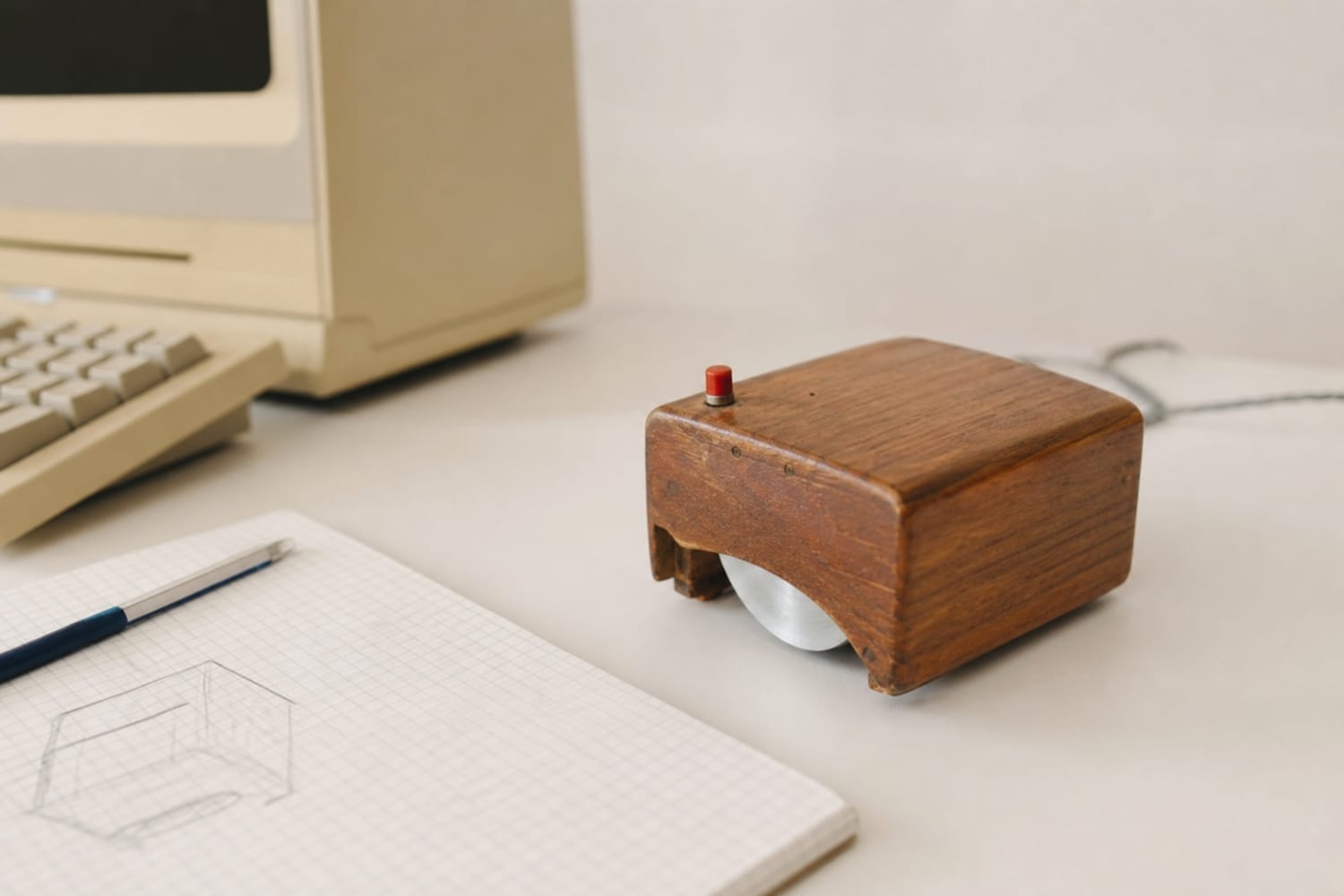
In the history of technology, some inventions announce themselves with drama: giant machines, glowing screens, rockets, robots, and devices that seem to belong to the future. Others arrive quietly, almost humbly, looking too simple to matter. The first computer mouse belonged to the second category. It was a small wooden box with wheels, a cord, and a single button. At first glance, it looked more like a handmade workshop experiment than a tool that would reshape human-computer interaction.
Yet that little wooden device helped change the way people use computers forever.
Before the mouse, computers were largely controlled through keyboards, punch cards, switches, and typed commands. Using them required specialized knowledge and patience. Computers were powerful, but they were not intuitive. The mouse introduced a different idea: instead of memorizing commands, a person could point, click, select, drag, and move through information visually. That simple shift helped turn computing from something reserved for experts into something ordinary people could eventually use every day.
The World Before Pointing and Clicking
To understand why the first mouse mattered so much, it helps to imagine computing in the early 1960s. Computers were enormous, expensive machines used mostly by universities, government agencies, and large corporations. They were not personal devices. They did not sit on desks in homes. Most people never interacted with them directly.
When users did communicate with computers, the experience was often slow and indirect. A programmer might prepare a stack of punch cards, submit them to an operator, and wait for results. Later, command-line interfaces allowed more immediate interaction, but they still required users to type precise instructions. A single typo could cause an error. There was little room for exploration.
The idea of using a computer visually, by moving a cursor around a screen, was radical. Screens themselves were not yet common as interactive displays. The concept of opening documents, selecting text, clicking icons, or dragging objects would have seemed futuristic. Computers were tools for calculation and data processing, not friendly workspaces.
This was the environment in which Douglas Engelbart began thinking differently.
Douglas Engelbart’s Vision
Douglas Engelbart, an engineer and inventor, was not simply trying to build a better input device. His goals were much larger. He believed computers could help humans think, communicate, solve problems, and collaborate more effectively. In an era when many saw computers as number-crunching machines, Engelbart imagined them as tools for augmenting human intelligence.
At the Stanford Research Institute, later known as SRI International, Engelbart led a team at the Augmentation Research Center. Their work focused on making computers more interactive and useful for complex intellectual tasks. They explored ideas such as hypertext, shared documents, screen-based editing, video conferencing, and collaborative computing. Many of these concepts would not become mainstream until decades later.
As part of this broader vision, Engelbart needed a better way for people to control what appeared on a screen. A keyboard alone was not enough. Users needed to move quickly around a visual workspace, select objects, and interact naturally with information. Several input devices were tested, including light pens, joysticks, and other mechanical controllers.
The device that proved especially promising was a small box that could roll across a surface.
The Wooden Prototype
The first computer mouse was built in the early 1960s by Engelbart and his colleague Bill English. It was made of wood and had two metal wheels underneath it. The wheels were positioned at right angles to each other: one tracked horizontal movement, and the other tracked vertical movement. As the device moved across a desk, it translated that motion into movement of a cursor on a screen.
The original mouse had a single button on top and a cable extending from the back. Because the cord resembled a tail, the team began calling it a “mouse.” The name was informal at first, but it stuck.
Compared with modern mice, the prototype was bulky and primitive. It had no optical sensor, no scroll wheel, no ergonomic curve, and no wireless connection. It was a simple mechanical object built to test an idea. But the idea was powerful: hand movement on a flat surface could correspond directly to movement on a screen.
That relationship between physical motion and digital action is now so familiar that it feels obvious. At the time, it was anything but.
The Mother of All Demos
The mouse received its most famous public introduction on December 9, 1968, during a presentation by Douglas Engelbart in San Francisco. This event is now widely known as “The Mother of All Demos,” and for good reason. In just about 90 minutes, Engelbart demonstrated a collection of technologies that seemed decades ahead of their time.
Sitting at a workstation, Engelbart used the mouse to control a cursor on a screen. He showed text editing, copying and pasting, hyperlinks, windows, document sharing, and real-time collaboration with a colleague located miles away. The audience watched as he navigated information in a way that looked astonishingly modern.
The mouse was only one part of the demonstration, but it played a central role. It made the interaction visible and fluid. Engelbart was not typing obscure commands for every action. He was pointing, selecting, and manipulating content in real time. The computer became less like a remote machine and more like an extension of the user’s thoughts and hands.
For those who understood what they were seeing, the demo revealed a possible future of computing.
Why the Mouse Was Revolutionary
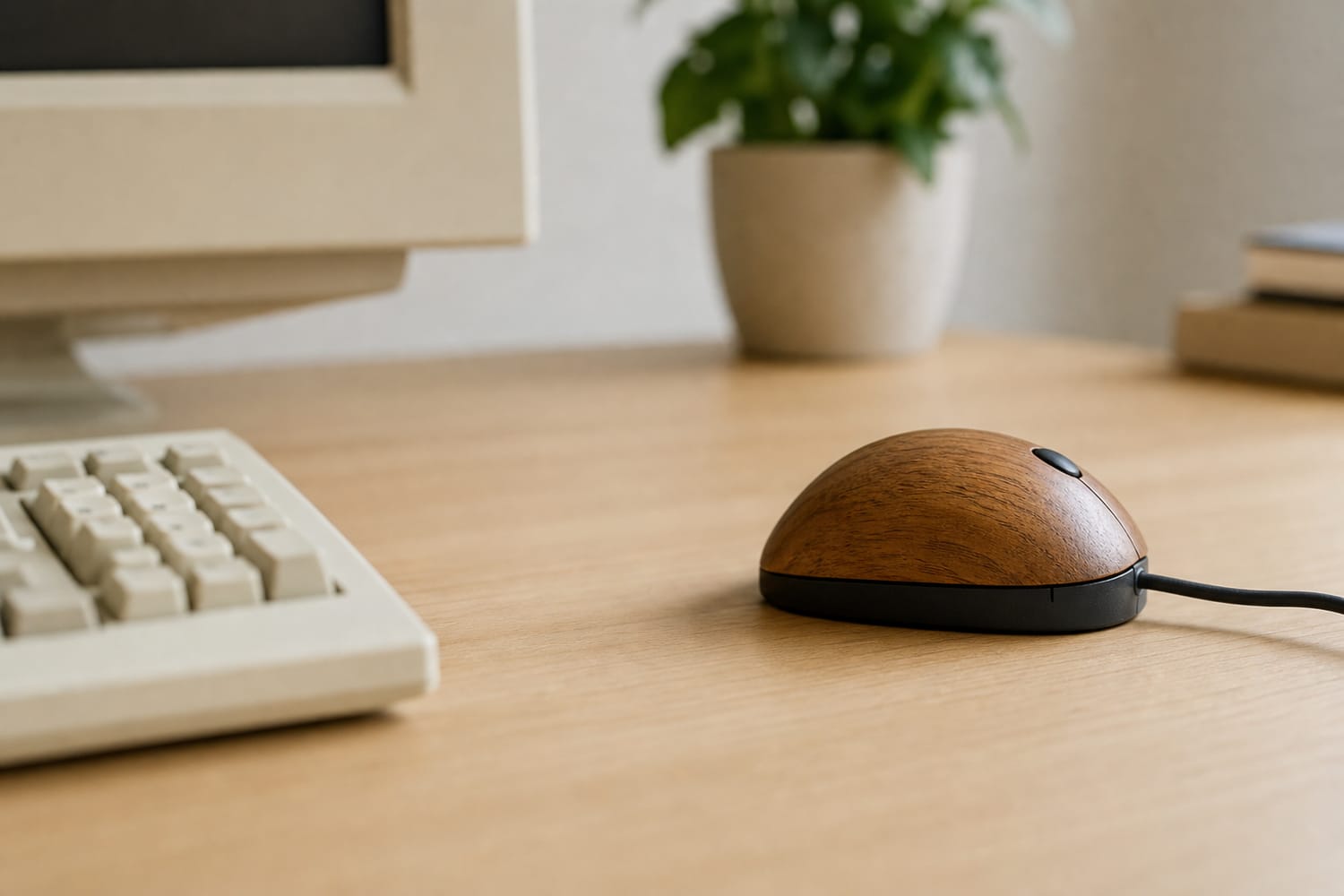
The mouse was revolutionary because it changed the relationship between people and computers. It helped make interaction spatial and visual. Instead of thinking only in terms of typed instructions, users could work with objects on a screen.
This shift may sound small, but it opened the door to graphical user interfaces, or GUIs. A GUI depends on the idea that users can interact with visual elements such as icons, menus, windows, and buttons. The mouse made those elements practical. It allowed users to point with precision and make selections quickly.
The mouse also reduced the mental barrier to using a computer. While early computers demanded technical fluency, pointing and clicking felt more natural. A person did not need to memorize as many commands. They could explore, experiment, and learn by doing. This helped computing move toward a broader audience.
Of course, the mouse did not accomplish this transformation alone. It worked alongside advances in displays, software design, microprocessors, and personal computers. But as an input device, it became one of the key bridges between human intention and digital response.
From Research Lab to Everyday Desk
Although Engelbart’s mouse was groundbreaking, it did not become an overnight success. Many influential technologies spend years in laboratories before reaching the public, and the mouse was no exception.
In the 1970s, researchers at Xerox PARC developed graphical computing environments that made extensive use of the mouse. Their work influenced later personal computers, including systems from Apple and Microsoft. The Xerox Alto, introduced in 1973, used a mouse and graphical interface, but it was mainly a research machine and was never sold as a mass-market product.
The mouse became more widely known in the 1980s. Apple’s Lisa, released in 1983, included a mouse and graphical interface, though it was expensive and commercially unsuccessful. The Macintosh, released in 1984, brought the mouse to a much larger audience. Its famous graphical interface encouraged users to click icons, open folders, move windows, and interact with software visually.
Eventually, Microsoft Windows helped make mouse-based computing standard on IBM-compatible PCs. By the 1990s, the mouse was no longer strange. It was expected. A computer without one felt incomplete.
The Design Evolution
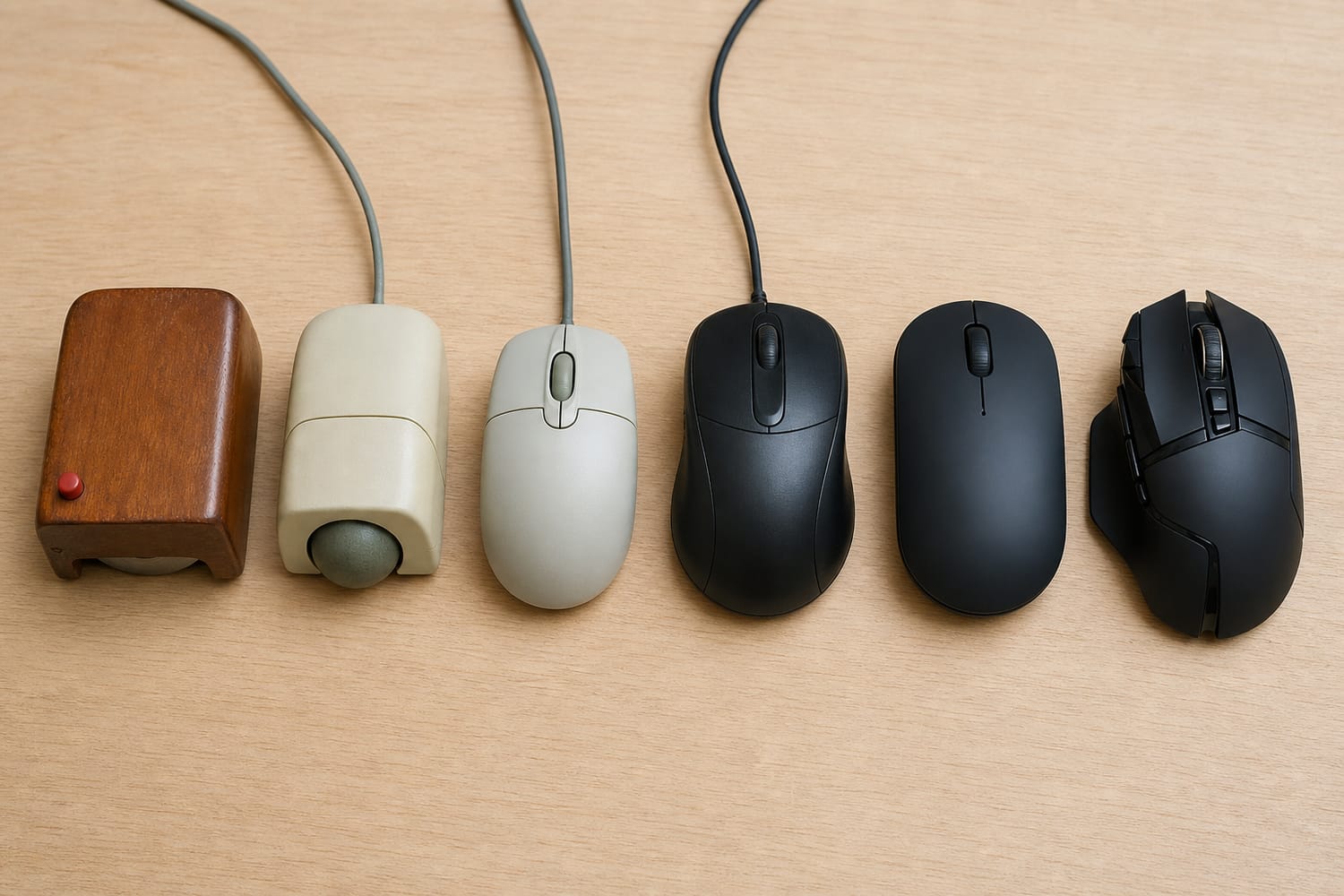
The original wooden mouse was only the beginning. Over time, mouse technology changed dramatically. The early wheel-based design gave way to the ball mouse, which used a rolling ball to detect movement in multiple directions. This became the dominant design for many years, though it had one annoying flaw: dust and dirt could collect inside, making the mouse less responsive.
Optical mice later replaced mechanical tracking with light-based sensors. They were more accurate, required less cleaning, and worked on a wider variety of surfaces. Laser mice improved precision further. Wireless mice removed the cord, giving users more freedom and cleaner desks.
Additional buttons, scroll wheels, touch-sensitive surfaces, and ergonomic shapes followed. Gaming mice introduced high-resolution sensors, customizable buttons, adjustable weights, and colorful lighting. Trackpads, touchscreens, and styluses also emerged as alternatives, especially on laptops, tablets, and smartphones.
Still, the basic idea remained remarkably consistent: a user moves a hand, and something moves or responds on a screen. The wooden box’s core concept survived every redesign.
A Tool That Changed Human Habits
The mouse did more than change computer hardware. It changed human habits. Words like “click,” “drag,” “drop,” “scroll,” and “double-click” became part of everyday language. Office workers, students, designers, engineers, gamers, and casual users all learned a shared physical vocabulary of computing.
The mouse also shaped software itself. Programs were designed around menus, buttons, toolbars, and visual feedback. Web browsing became deeply tied to clicking links. Creative software used the mouse for drawing, editing, selecting, and arranging. Even when touchscreens became popular, many of their gestures borrowed from mouse-based thinking: selecting, tapping, dragging, and moving objects directly.
It is easy to underestimate technologies that become ordinary. Once they are everywhere, they disappear into the background. The mouse is one of those inventions. For decades, it sat beside keyboards on desks around the world, quietly enabling billions of interactions.
The Enduring Importance of a Wooden Box
Today, many people use trackpads, touchscreens, voice assistants, and gesture controls. The mouse is no longer the only symbol of computer interaction. In some areas, it has been replaced or supplemented by newer tools. Yet it remains widely used because it is precise, efficient, and familiar.
The first mouse reminds us that transformative inventions do not always look impressive at the beginning. A wooden box with wheels might seem insignificant compared with the sleek devices it eventually inspired. But its importance was not in its appearance. Its importance was in the new relationship it created between humans and machines.
Douglas Engelbart’s invention helped make computers more approachable, more visual, and more interactive. It contributed to a future in which people could work with digital information directly rather than communicate only through rigid commands.
That small wooden mouse did not merely move a cursor. It moved technology toward the modern world.