A Simple Problem in a Shared Office
Long before livestreams, video calls, smart doorbells, and always-on social media feeds, one of the internet’s most charming inventions began with a very ordinary frustration: walking to the coffee room and finding the pot empty.
In the early 1990s, researchers at the University of Cambridge Computer Laboratory worked in a building where the coffee machine was located in a room known as the Trojan Room. For the people whose offices were nearby, checking the pot was easy. For others working on different floors or in distant parts of the building, the trip could be annoying—especially if it ended in disappointment.
The solution was not a memo, a schedule, or a rule about refilling the pot. It was a camera.
That camera, pointed at a humble coffee pot, became what is widely remembered as the first webcam ever built. It was not created to change the world. It was created to save a few steps. Yet the Trojan Room coffee pot would become a small but important milestone in internet history, showing how networked cameras could connect people to remote places in real time.
The Birth of the Trojan Room Coffee Cam
The first version of the coffee cam was set up in 1991 by researchers Quentin Stafford-Fraser and Paul Jardetzky. At the time, the World Wide Web was still in its infancy, and most people outside academic and research circles had little experience with the internet as we know it today.
The camera was connected to a local network inside the Cambridge Computer Laboratory. Its job was simple: capture an image of the coffee pot and make that image available to people in the building. Researchers could check their computer screens before making the trip to the Trojan Room. If the pot looked full, the journey was worthwhile. If it was empty, they could stay at their desks and avoid frustration.
The system used a small camera connected to a computer that grabbed images of the coffee pot. The pictures were low-resolution, grayscale, and updated only periodically. By modern standards, the image quality was primitive. But for the time, the idea was clever, practical, and surprisingly futuristic.
It allowed people to see something happening in another room without being physically present. That concept now feels completely normal. In 1991, it was novel enough to become legendary.
Before Webcams Were “Web” Cams
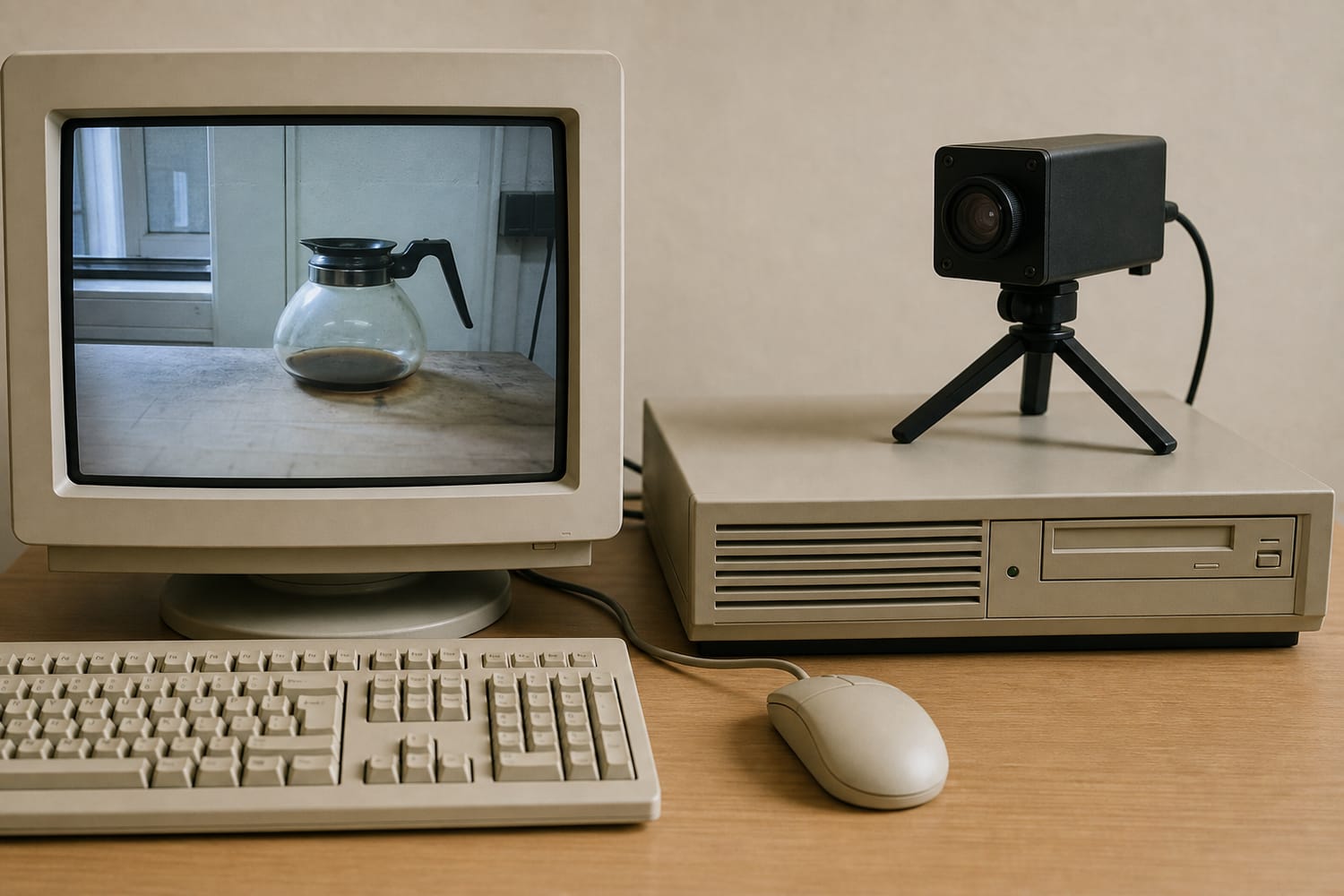
One of the interesting details about the Trojan Room coffee cam is that it did not begin as a webcam in the modern sense. When it was first created, it was not available through a web browser. It ran on the laboratory’s internal network and used software that displayed the coffee pot image on researchers’ workstations.
The original program was called XCoffee, designed for the X Window System, which was commonly used on Unix workstations. This made it useful for the people inside the lab, but invisible to the wider world.
That changed in 1993, when the coffee cam was connected to the World Wide Web. Researchers Daniel Gordon and Martyn Johnson helped make the coffee pot image accessible online. Once that happened, anyone with an internet connection and a suitable browser could check the status of the coffee pot at Cambridge.
Suddenly, a private convenience became a public curiosity.
People from around the world began visiting the page—not because they needed coffee from the Trojan Room, but because they could. The appeal was simple and strange: here was a live view into a real place, updating across the internet. It was mundane, but it was also magical.
Why a Coffee Pot Captured the Internet’s Imagination
The coffee pot became famous partly because it was funny. The idea that sophisticated computer scientists had used advanced networking technology to monitor coffee levels was delightfully human. It showed that innovation does not always begin with grand ambitions. Sometimes it begins with laziness, impatience, or the desire for caffeine.
But the coffee cam also captured something deeper about the internet’s early culture. The web in the 1990s was filled with experiments. People built pages because they could. They shared projects, jokes, tools, and curiosities without always knowing what they might become.
The Trojan Room coffee pot fit perfectly into that world. It was useful, playful, and open-ended. It did not sell anything. It did not demand attention with polished design or marketing. It simply showed a coffee pot.
For many early internet users, that was enough. The novelty of seeing a live image from another location was powerful. It suggested a future in which distance mattered less, where remote observation and communication could become part of everyday life.
Today, that future is everywhere.
The Technology Behind the Famous Pot
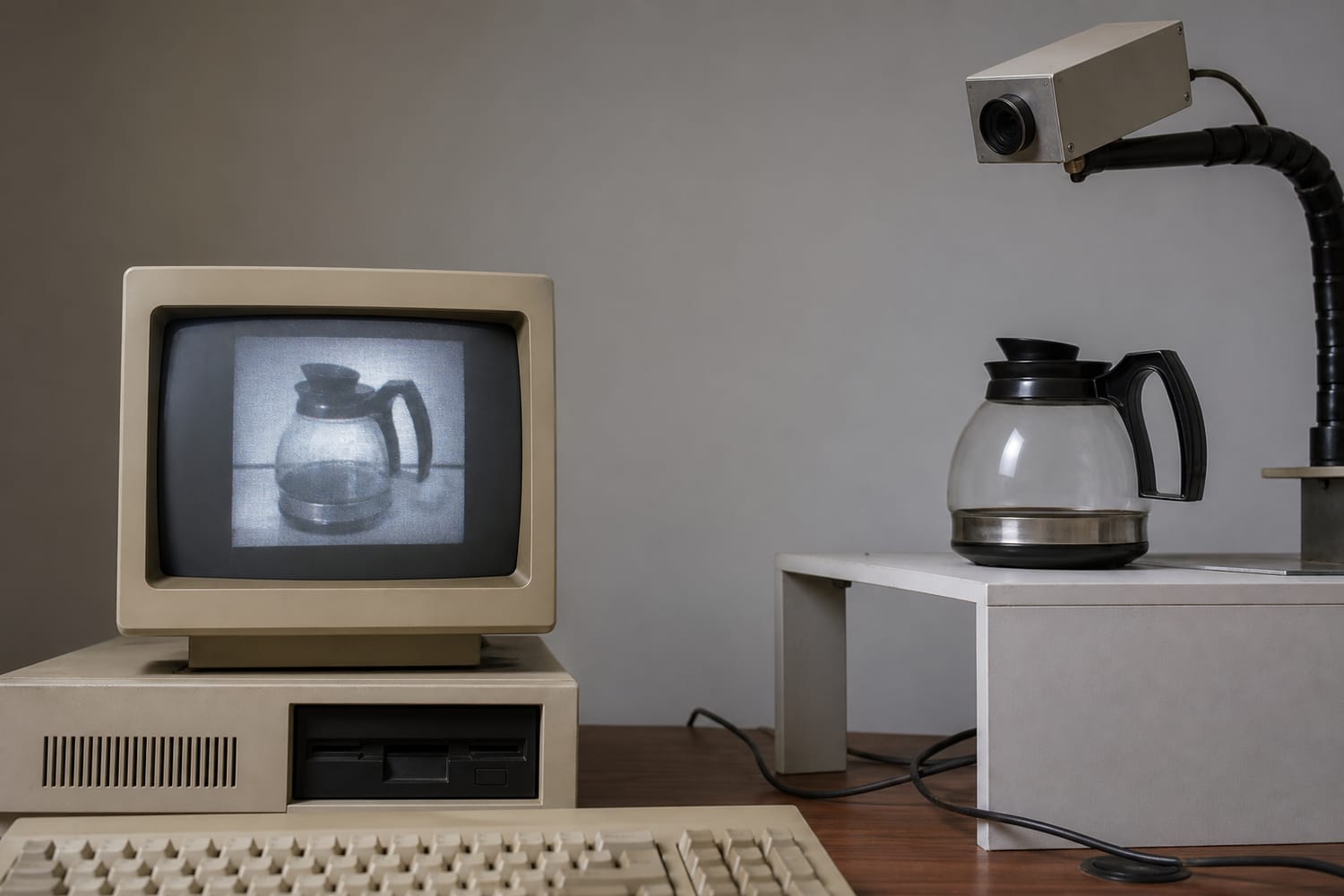
Compared with modern webcams, the Trojan Room setup was extremely basic. The image was small, black-and-white, and slow to refresh. There was no high-definition video, no audio, no face tracking, no cloud storage, and no mobile app.
Yet the essential ingredients were there: a camera, a computer, a network, and a way for users to view the output remotely.
The system captured still images rather than streaming smooth video. The images were updated at intervals, allowing users to see whether the coffee level had changed. This was enough for its purpose. Nobody needed cinematic quality to determine whether there was coffee in the pot.
Its simplicity was part of its brilliance. The coffee cam solved a specific problem with the tools available at the time. It did not overcomplicate the task. It also demonstrated a pattern that would later become central to internet-connected devices: take a real-world object, attach a sensor or camera, connect it to a network, and make its status visible remotely.
That pattern now defines countless technologies, from home security systems to baby monitors to traffic cameras to industrial sensors.
From Office Convenience to Internet Icon

As the coffee cam gained fame, it became a symbol of early web culture. Visitors who had no connection to Cambridge would check the pot simply to participate in the novelty. The coffee pot became one of the internet’s first shared live experiences.
It was also one of the earliest examples of what we might now call ambient information. The camera did not tell a dramatic story. It provided a quiet, ongoing glimpse into ordinary life. People could look in whenever they wanted and see whether anything had changed.
This kind of passive, real-time connection would become a major part of the internet. Modern users constantly check feeds, dashboards, maps, cameras, and status indicators. The coffee cam foreshadowed that behavior in miniature.
In a way, it was less about coffee than presence. It made a distant object feel available. It turned a room most viewers would never enter into a place they could casually observe.
That was a new kind of experience.
The End of the Original Webcam
The Trojan Room coffee cam remained online for years, long after its practical purpose had been overshadowed by its fame. By the late 1990s and early 2000s, webcams had become far more common. People were using them for personal websites, offices, public spaces, and eventually video chat.
In 2001, the Cambridge Computer Laboratory moved buildings, and the original coffee cam was switched off. Its final moments were watched by many people online, a fitting farewell for a device that had become a small celebrity.
The coffee pot itself was auctioned on eBay and sold for thousands of pounds to the German news magazine Spiegel Online. What had once been an ordinary kitchen object had become a piece of internet history.
The shutdown marked the end of the original stream, but not the end of its influence. The idea it represented had already spread far beyond Cambridge.
The Legacy of the Coffee Pot
The first webcam did not emerge from a corporate product launch or a visionary business plan. It came from researchers who wanted to know whether coffee was available.
That is what makes the story so memorable. The Trojan Room coffee pot reminds us that technological revolutions often begin with small, practical problems. The internet itself grew through experiments, hacks, and shared solutions. Some became essential infrastructure. Others became cultural landmarks. The coffee cam managed to be both modest and meaningful.
Today, cameras connected to networks are everywhere. We use them for work meetings, online classes, livestreams, security, entertainment, medicine, science, and family conversations. Billions of people now take real-time visual connection for granted.
But before all of that, there was a grainy image of a coffee pot in a Cambridge lab.
It was not glamorous. It was not fast. It was not designed for fame. Yet it showed the world something important: the internet could let us look across distance into everyday life as it happened.
And all because someone wanted to avoid a wasted trip for coffee.