A Game Older Than the Pyramids
Senet is widely recognized as the world’s oldest recorded board game. Played in Egypt more than 5,000 years ago, it entertained people from different levels of society and eventually became a powerful symbol of death, rebirth, and the afterlife. Its original rules have disappeared, but surviving boards, artwork, and religious texts reveal its extraordinary place in Egyptian culture.
The earliest objects identified as Senet boards come from Predynastic and First Dynasty burials, with examples dating to approximately 3500 and 3100 BCE. That makes the game older than the Great Pyramid of Giza by several centuries. Guinness World Records recognizes Senet as the earliest recorded board game, although even older games may once have been played without leaving clear archaeological evidence.
Its name is commonly translated as “passing,” an appropriate description for a race in which pieces moved across a board. Over time, however, passing came to mean more than advancing toward a finish line. It could also represent the soul’s passage from the earthly world into eternity.
What a Senet Board Looked Like
The classic Senet board contained 30 squares arranged in three parallel rows of ten. Players used two contrasting sets of pieces, often shaped like cones and spools. Depending on the historical period or modern reconstruction, each player may have controlled five or seven pieces.
Rather than rolling modern cubic dice, players probably threw marked sticks or knucklebones. The way these objects landed determined how many spaces a piece could move. This introduced an element of chance while leaving room for strategic decisions.
Senet boards varied greatly in quality. A person of limited means could scratch a simple grid onto stone, wood, pottery, or the ground. Wealthier Egyptians owned carefully crafted boxes decorated with ivory, paint, or religious symbols. Some included drawers for storing the pieces.
One Senet game box in the British Museum, dated to approximately 1400–1200 BCE, combines a wooden storage box with a playing surface divided into 30 squares. Such portable designs show that Senet sets could be both practical household objects and expressions of craftsmanship.
How the Game May Have Been Played
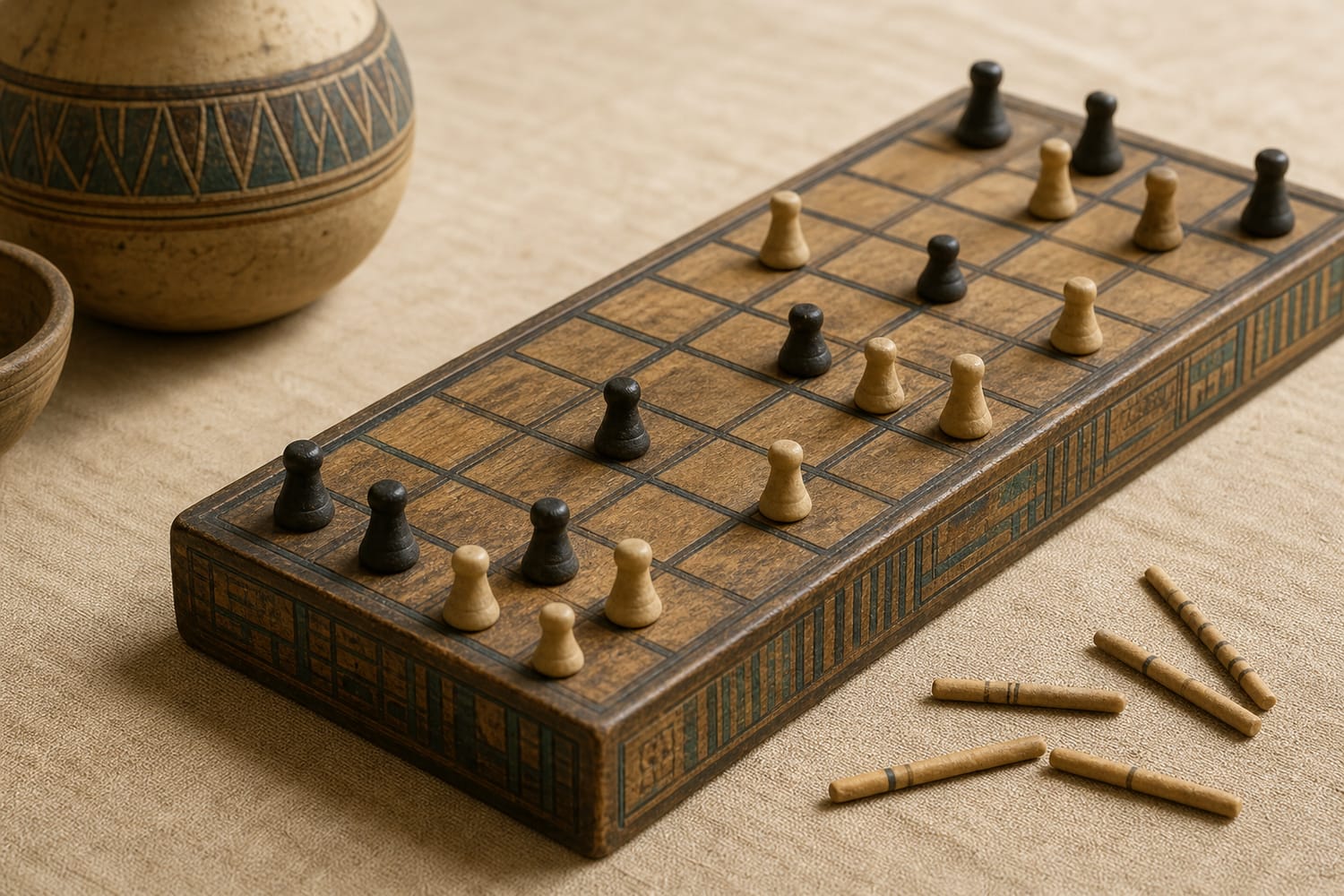
No complete ancient rulebook for Senet has survived. Every modern version is therefore a reconstruction based on boards, painted scenes, inscriptions, and comparisons with other race games.
Players appear to have followed a winding path. Pieces moved along the first row, reversed direction across the second, and turned again for the final row. The object was probably to move every piece safely off the board before the opponent did.
Common reconstructions include several basic features:
- A throw of sticks determined movement.
- Opposing pieces could block one another.
- Landing on an opponent’s unprotected piece might exchange their positions.
- Two or more connected pieces could form a protected group.
- Certain marked squares offered safety or created danger.
- The first player to remove every piece won.
The rules were likely simple enough to learn quickly but unpredictable enough to make each contest exciting. A favorable throw could rescue a threatened piece, while a poor decision might allow an opponent to seize the advantage.
Anyone curious about reconstructed play can explore the Egypt Exploration Society’s resource on games in ancient Egypt, which discusses both Senet and the snake-shaped game Mehen.
Entertainment Across Egyptian Society
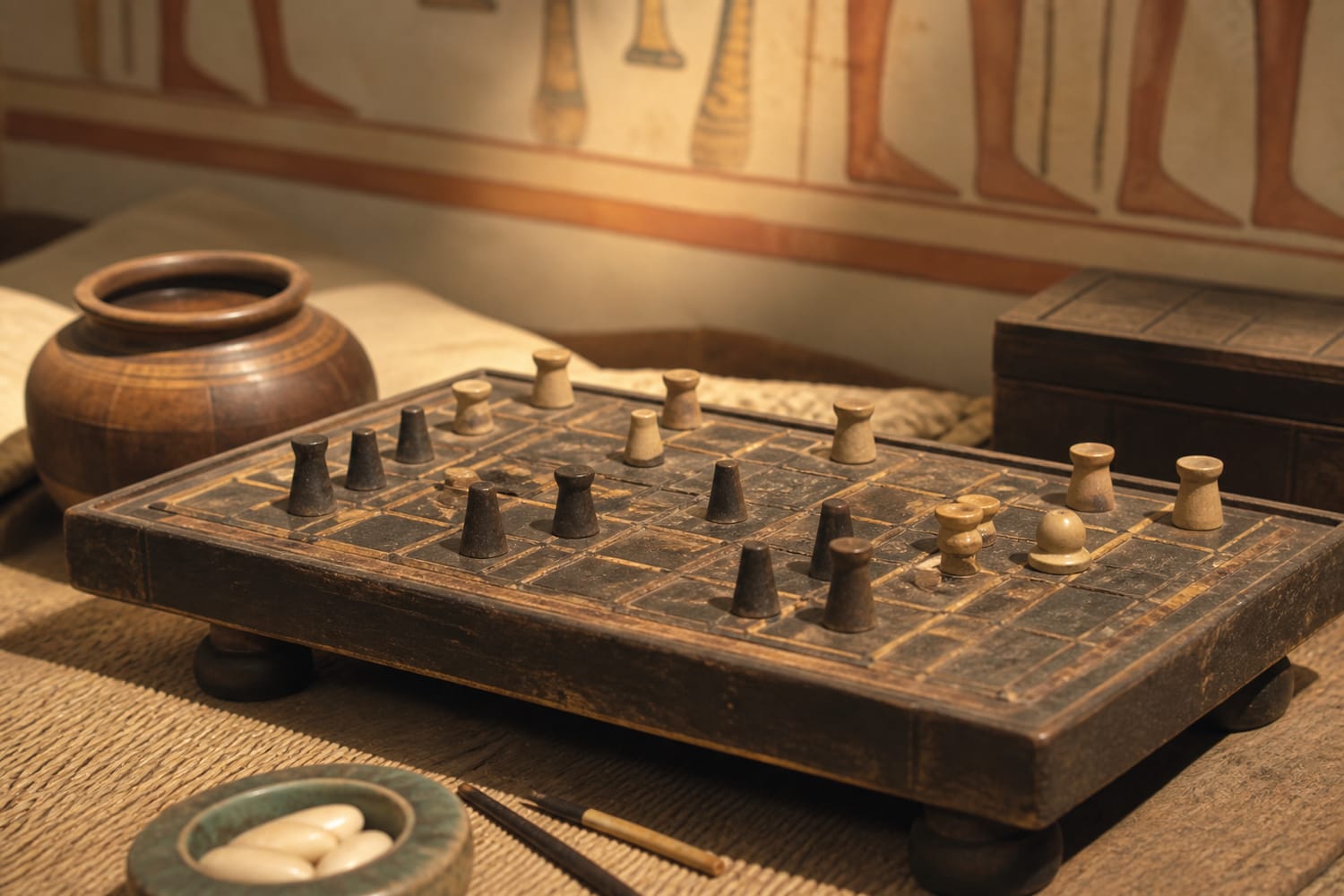
Senet’s remarkable longevity suggests that it appealed to more than one social group. Royal families owned elaborate sets, but simpler boards indicate that the game was not restricted to palaces. Officials, artisans, and other Egyptians could enjoy it during periods of rest.
Tomb paintings provide especially valuable evidence. They portray players seated across from one another, concentrating on the board much as people gather around games today. One famous scene shows Queen Nefertari, the wife of Ramesses II, playing Senet in her tomb in the Valley of the Queens.
The game may have encouraged friendly competition, conversation, and strategic thinking. Because a match combined choice with chance, success depended partly on judgment and partly on forces outside the player’s control. That balance must have produced suspense, frustration, and triumphant reversals familiar to modern board-game enthusiasts.
Senet also offers a glimpse of Egyptian life beyond monuments and royal ceremonies. Ancient Egyptians worked, worshiped, raised families, told stories, and looked for ways to relax. The game belongs to that human side of history, just as the first recorded labor strike by Egyptian tomb workers reveals the everyday concerns behind Egypt’s magnificent burial sites.
From Household Pastime to Sacred Journey
Senet did not remain purely recreational. During the New Kingdom, its board increasingly became a symbolic map of the soul’s journey through the underworld.
Egyptians believed that death was a transition rather than a final ending. The deceased faced hazards and judgments before reaching an ideal eternal existence. Senet’s dangerous spaces, protective squares, reversals, and final escape from the board fitted naturally into this religious worldview.
Some later boards featured hieroglyphic signs connected with water, goodness, and solar deities. The final squares could represent stages near the completion of the soul’s journey. Winning the game therefore echoed a successful passage through the supernatural dangers separating death from rebirth.
Senet also appears in Spell 17 of the Book of the Dead. Tomb scenes occasionally show the deceased playing against an invisible opponent, suggesting a contest involving fate or divine powers. The player was no longer simply trying to defeat another person; the symbolic goal was to overcome obstacles and enter the afterlife.
This transformation helps explain why Senet sets were placed in tombs. Like food, clothing, furniture, and other grave goods, the board could serve its owner beyond death. It was at once a familiar comfort and a model of spiritual survival.
Senet in Royal Tombs and Archaeology
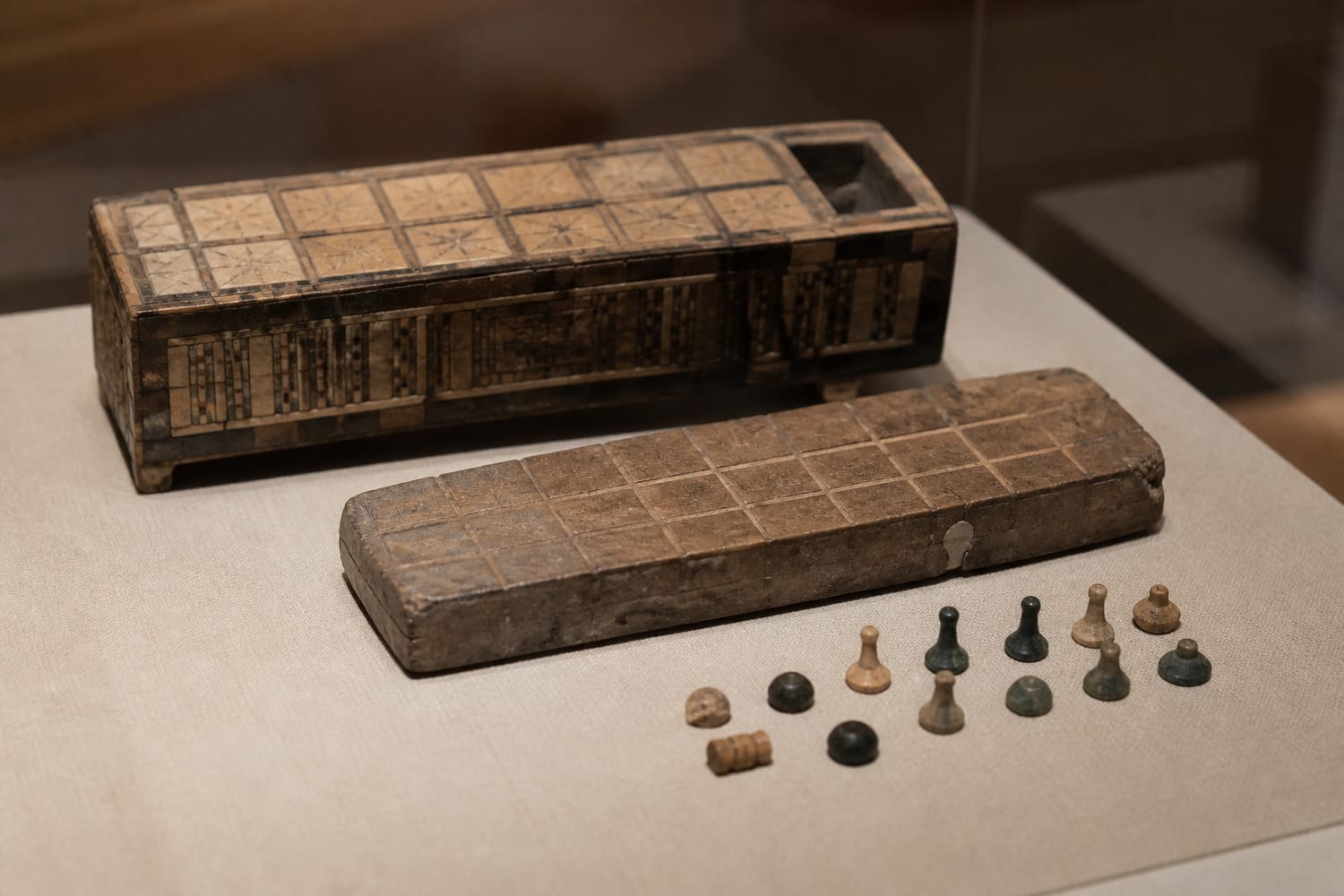
Archaeologists have recovered Senet boards or gaming pieces from numerous Egyptian sites. The dry climate preserved materials that might otherwise have decayed, allowing researchers to study differences in construction, decoration, and symbolism.
Several gaming boxes were discovered in the tomb of Tutankhamun. These luxurious objects demonstrate that Senet remained important among royalty during the 18th Dynasty. Their presence alongside the young pharaoh’s other possessions suggests that games were considered appropriate equipment for eternity.
Not every surviving board was luxurious. A British Museum pottery fragment identified as a Senet board preserves part of a roughly scored grid and several signs. It demonstrates how an ordinary ceramic object could be adapted for play.
These contrasting finds—from finely decorated boxes to improvised grids—help establish Senet as both an elite treasure and an accessible pastime.
Why the World’s Oldest Board Game Still Matters
Senet lasted for thousands of years because it could serve several purposes at once. It brought people together, rewarded tactical decisions, generated suspense, and expressed beliefs about fate. Later, it helped Egyptians imagine the uncertain passage from death to eternal life.
The game also reminds us that play is not a modern luxury. Long before electronic entertainment, printed cards, or mass-produced game pieces, people created structured worlds governed by competition, chance, and shared rules.
Although the exact ancient rules may never be recovered, Senet’s appeal remains understandable. Two players face each other across a board, hoping for a fortunate throw and searching for the best move. Across more than five millennia, that simple experience still connects the living world with the players of ancient Egypt.